


Text: Jutta Berger
The text was published in issue 2 (3/26).
Reading time 3 Min.
Love, Glamour, and a World in Shards
A giant broken mirror wall on the Seebühne becomes a symbol of vulnerability and impending doom. The stage design of La traviata presents a challenge for the technical department—one that is mastered with ingenuity and meticulous problem-solving skills.
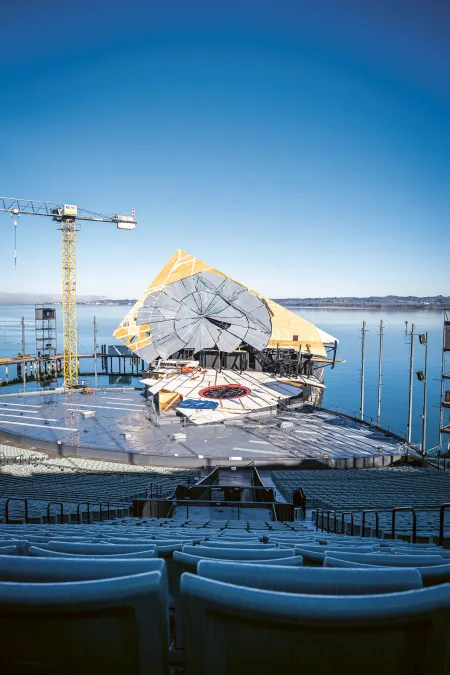
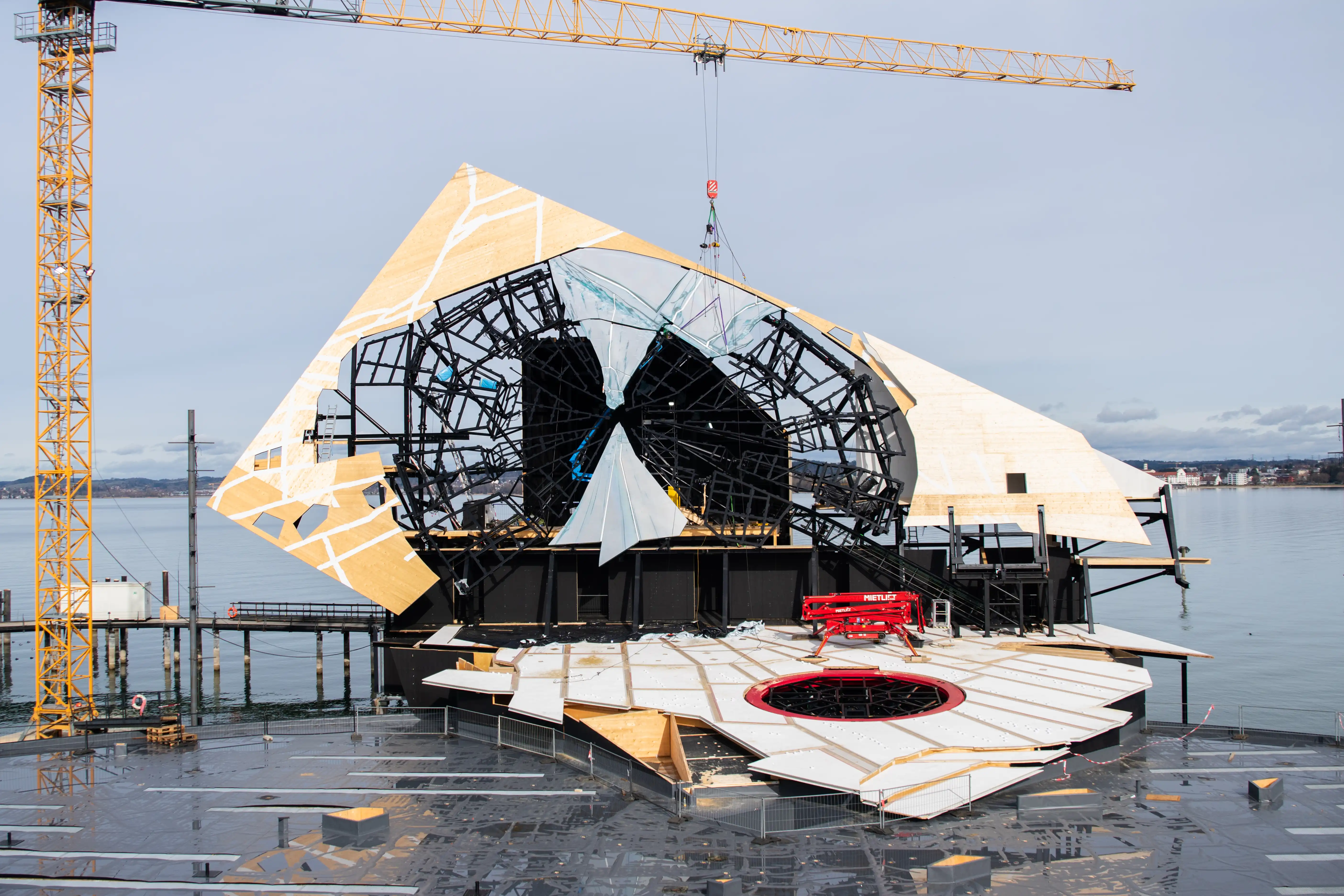
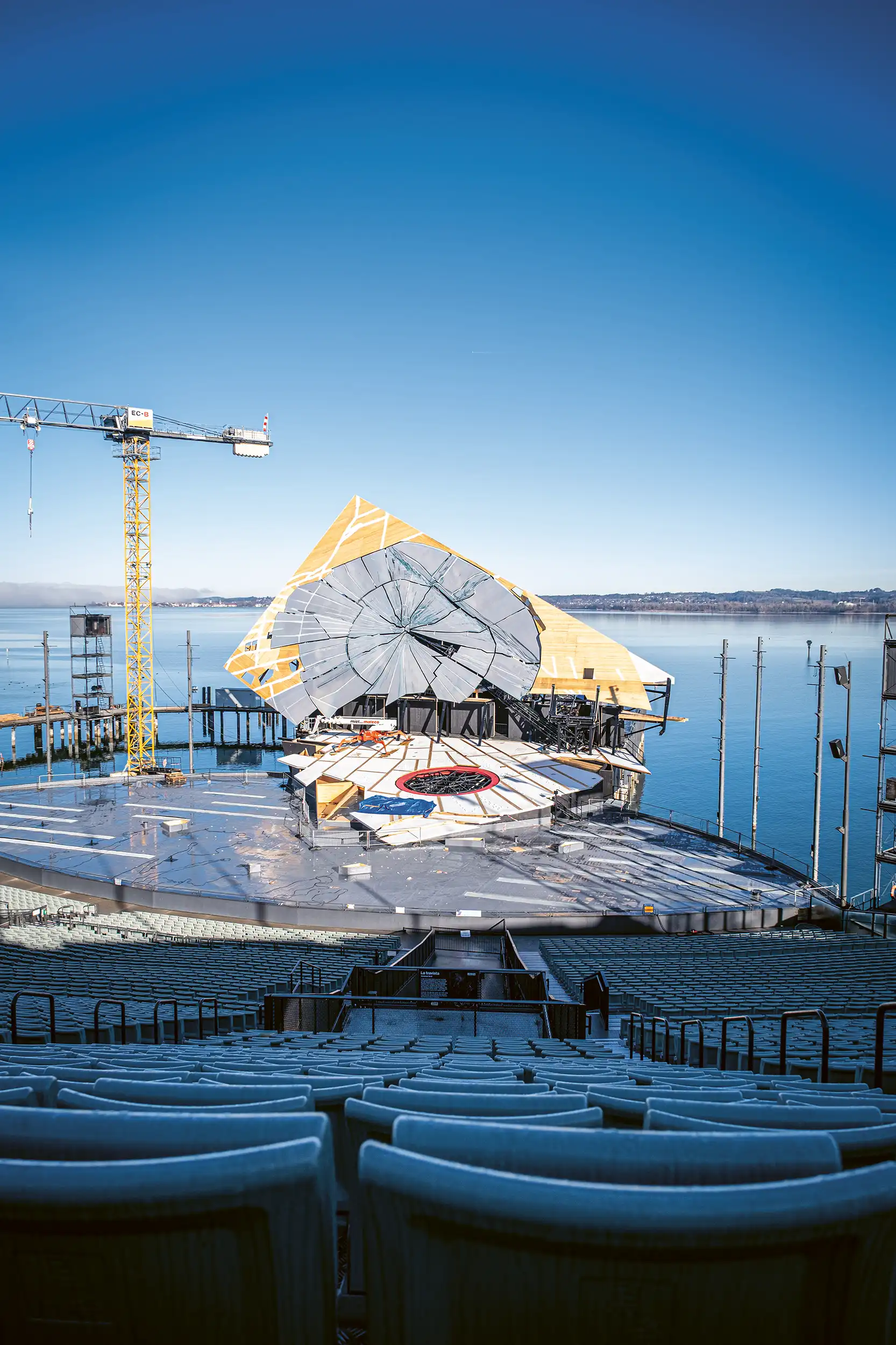
High and jagged, it already rises from the lake: the symbolic heap of shards for the stage of La traviata. The vast, splintered mirror wall is intended to “sharpen our perception of the fragility of a person who chooses love and breaks under its weight,” as director Damiano Michieletto describes his concept. To realize this vision, stage designer Paolo Fantin works alongside the technical team of the Bregenzer Festspiele, a well-practiced group of inventive problem-solvers. Their expertise is essential to every production on the Seebühne. “Very often, ideas on paper are fantastic, but in reality, one must solve ten times more technical problems for the Seebühne than for a conventional stage,” explains artistic director Lilli Paasikivi. Safety, wind, and weather must all be taken into account; the stage design has to withstand four seasons and two summers.
A Convincing Illusion of Materials
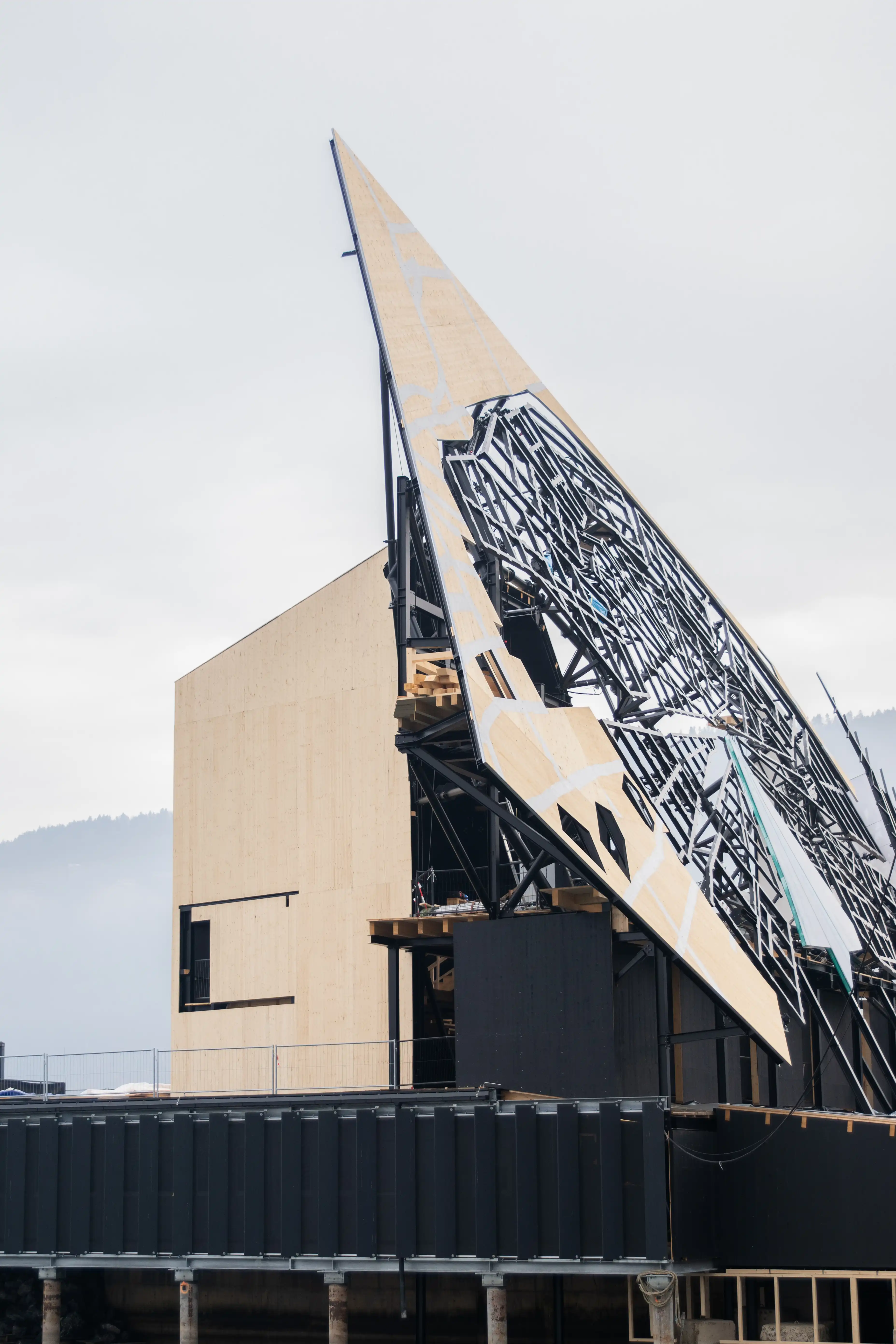
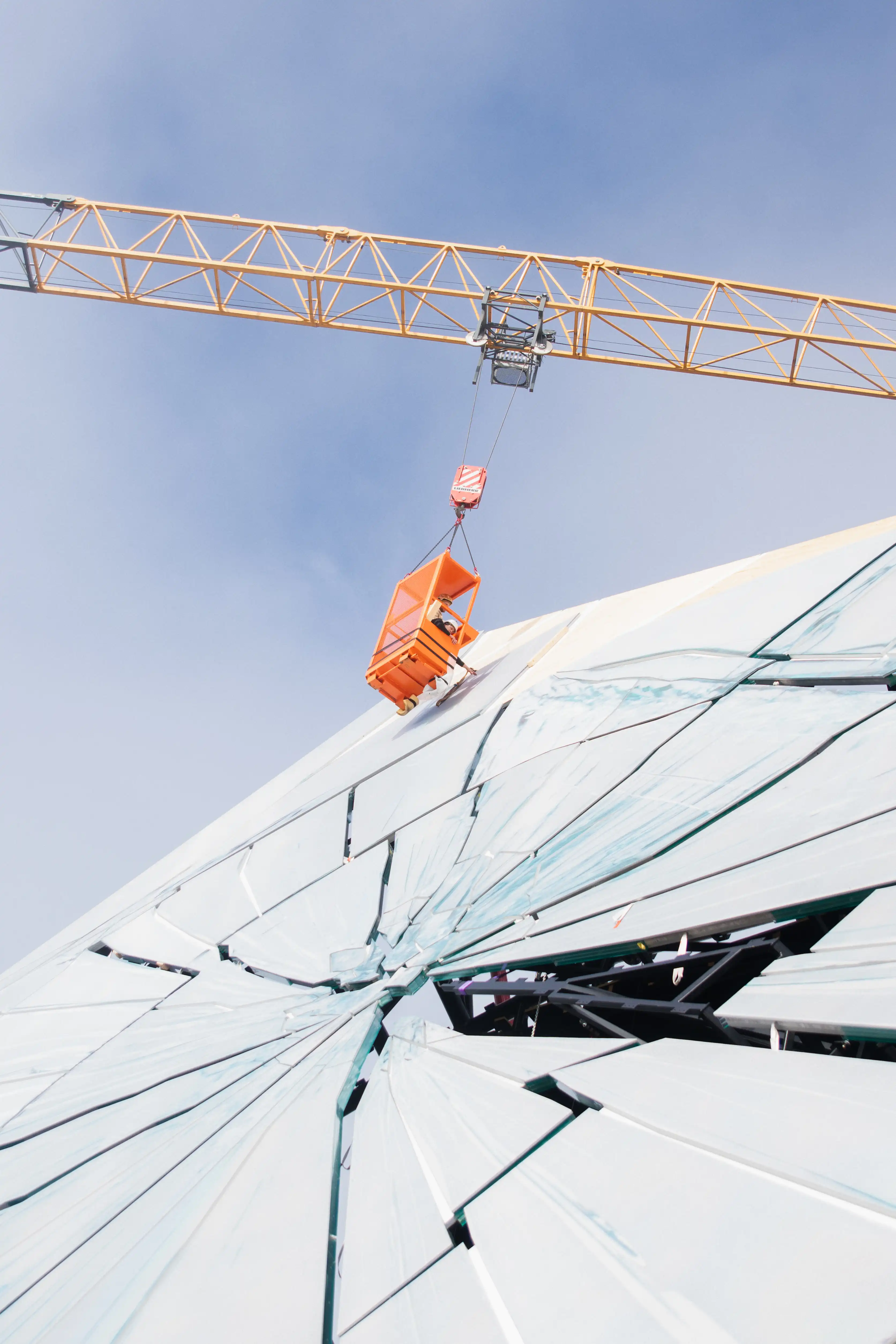
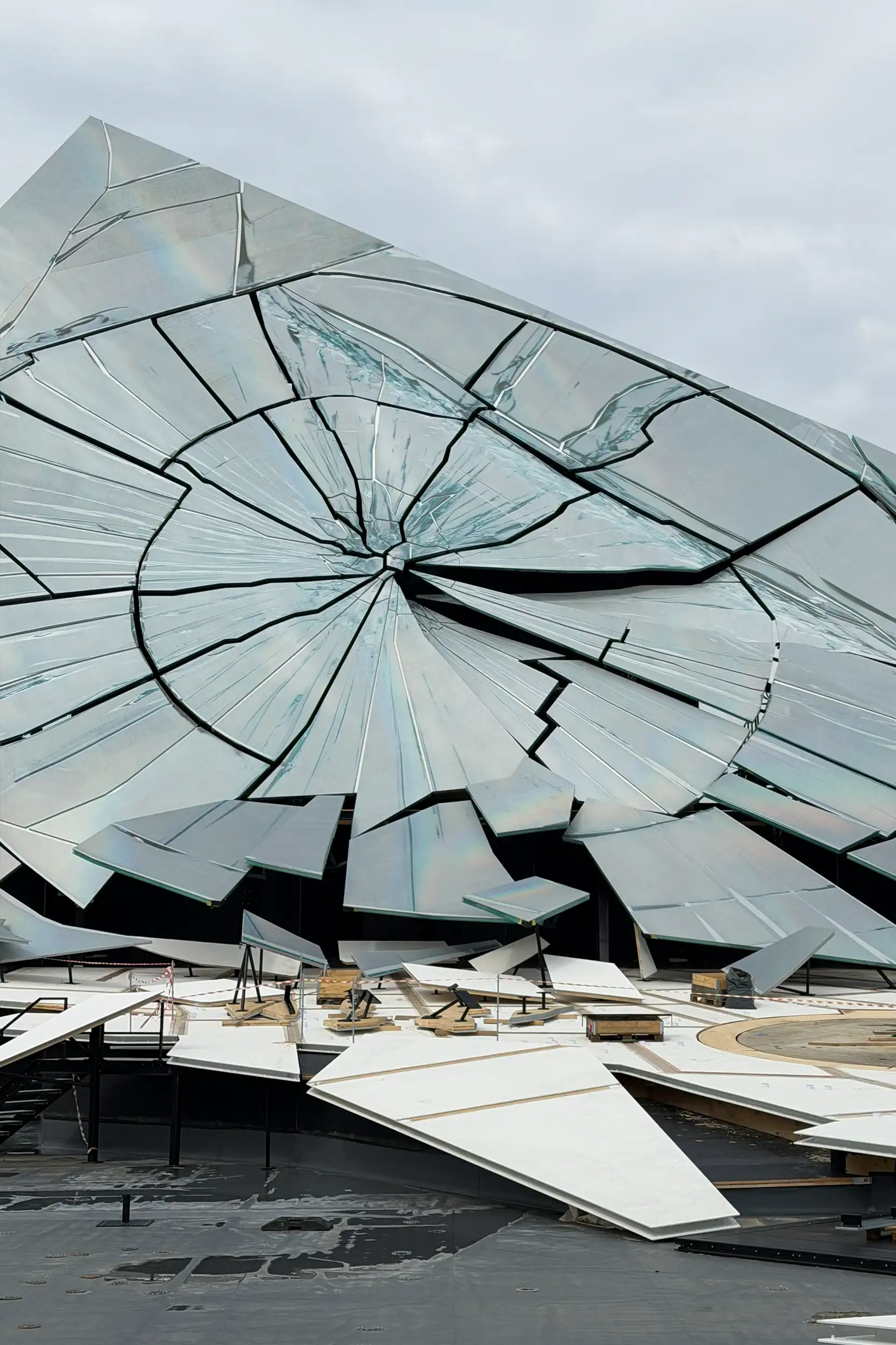
It quickly became clear that a real mirror wall on the Seebühne would be impossible. Mirror glass would be too unsafe and would create harsh reflections. The team therefore searched for a suitable material and found an obvious solution: wood. The shards were cut from wooden panels and covered with a fine plastic fabric which, thanks to its coating and coloring, simulates reflective surfaces. This way, around 700 square meters of deceptively realistic mirror surface were created, composed of 86 shards of varying dimensions: The largest measures 12 meters in length and two and a half meters in width, while the smallest, comparatively tiny, measures just 40 by 20 centimeters.
Producing the frames with the mirror-like printed fabric may sound simple, but it is not. Head of the art department Susanna Boehm explains: “Our team developed a special machine specifically for the precise application.” Like on an industrial production line, the fabric is pressed exactly onto frames sprayed with adhesive. To enhance the glass effect, the visible edges are covered with green-tinted twin wall sheets. These small details contribute significantly to the overall visual impact.
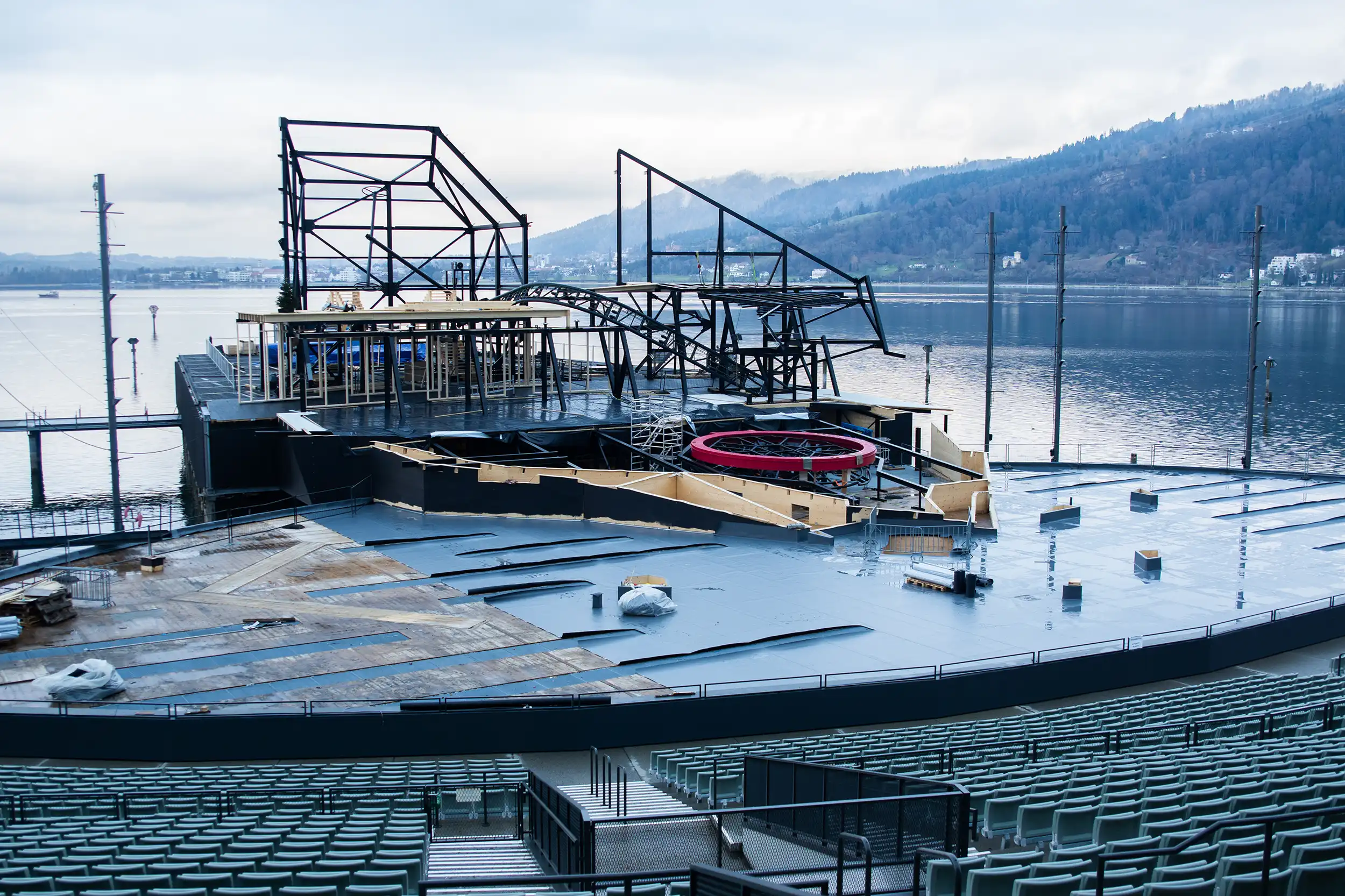
390 square meters, which is more than half of the mirror wall, can be moved.
A Transformable Mirror Wall
Technical director Wolfgang Urstadt looks forward to the first activation with anticipation, as “390 square meters, which is more than half of the mirror wall, can be moved. The largest shards have three joints. Openings are created outward and inward. Platforms appear.” Bringing the machinery and control system into operation for the first time after installation—“seeing whether the computer simulation of the movements can be realized in reality—that is an exciting moment.”
Susanna Boehm highlights another symbolically rich detail of the stage: “A huge black sphere, six meters in diameter, resembling a magic ball”—a powerful visual element that embodies the looming fate hanging over Violetta. That is all we will say for now.
When Giuseppe Verdi celebrated the world premiere of La traviata (translated as “the fallen woman”) in 1853, he caused a scandal: For the first time, an opera placed a courtesan at its center and portrayed her as a human being with emotions and inner conflicts. In Bregenz, Michieletto and Fantin set the production in the Roaring Twenties. The stage becomes a party location, the large water basin an infinity pool—for Michieletto, an expression of a “cynical, capitalist, fascinating world that wants to consume and has no time to lose.”
La traviata
Giuseppe Verdi
22 July 2026 – 9.15 p.m. Premiere
Seebühne

