


Text: Babette Karner
The text was published in issue 2 (3/26).
Reading time 5 Min.
The First Dance of Summer
Months before the Seebühne comes alive, preparations for the new season at the Bregenzer Festspiele are already underway, shaped by careful planning and quiet anticipation. Between the swing of jazz melodies, the soft rustle of measuring tapes and the shimmer of sequins, the dance audition for La traviata offers an early glimpse of the summer of 2026—when the spirit of the Roaring Twenties will sweep across the Seebühne.

Outside, autumn mist drifts over Lake Constance, while inside the Festspielhaus, time seems to follow a different rhythm. On this November day, it almost feels like midsummer. Dancers and festival staff move briskly through the corridors; there is laughter, concentration, and the constant rhythm of movement on the stage. One floor above, in the Saal Bodensee, the costume, hair and make-up departments have created improvised studios: racks of garments, measuring tapes, mirrors, and cameras. The occasion? The dance casting for the Seebühne production of La traviata.
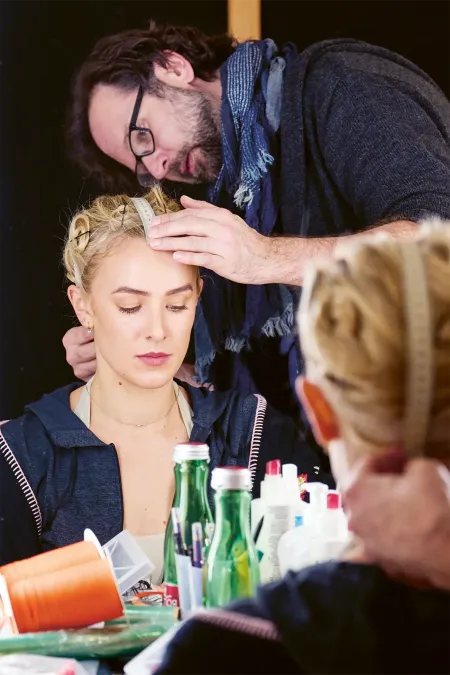
The air carries the scent of hair spray and fresh textiles. “We are already taking measurements for the costumes so we can start immediately,” explains Lenka Radecky, head of the costume department, smiling as she notes a string of numbers. Nearby, Frauke Gose, head of the hair and make-up department, nods in agreement while expertly braiding a dancer’s long black hair into a thick plait. Further back in the room, a slender young woman in a red-and-black glittering suit spins slowly in front of the large mirror, watching the sequins catch the light—a sparkling prelude to the visual language of the new Seebühne production, where glamour will meet melancholy.

Between Verdi and “De-Lovely”
Down on the empty black main stage, the second group of the 34 candidates begins to warm up.
Harsh rehearsal lights blaze above, leaving the space stark and minimalist. Choreographer Thomas Wilhelm counts the dancers in. Suddenly the room fills with elegant jazz tunes: Ella Fitzgerald sings “It’s De-Lovely”. “And now the turn!” Wilhelm calls out over the beat.
It is the age of jazz, the spirit of the Roaring Twenties, unfolding through movement. And though the summer will, of course, be ruled by the music of Giuseppe Verdi, this production brings the vibrant pulse of the 1920s to the shores of Lake Constance. The choreography hints at the journey ahead. “Go across the diagonal. —then jump, jump, jump!” the choreographer directs. A quick sip of water, a brief moment to catch their breath, and they go again. “Don’t rush—give each movement its space!” As the groups grow smaller, Wilhelm’s attention sharpens. Every detail matters: the clarity of a jump, the precision of an arm line. After the casting, he must decide who will stand on the Seebühne in summer. At times he demonstrates the steps himself, almost flying across the floor. “The movements must flow into one another,” he explains. “They must never appear abrupt.”
A Routine of Waiting and Discipline
The atmosphere is unmistakably international. Italian, English, Spanish and German drift across the stage in a lively chorus. The candidates come from different worlds: graceful ballet dancers, powerful modern dance specialists, experienced musical performers. Faces begin to glisten; breathing grows heavier. The sequence has been repeated countless times, yet Ella Fitzgerald is still singing. To an outsider, the situation might appear intense, even daunting. For the dancers, however, it is simply part of daily life—the constant testing of one’s craft under the watchful eyes of those who must decide. Finally, a break. Along the edge of the stage lie small clusters of belongings—clothes, backpacks, shoes and water bottles scattered across the black-painted floor. Nearby stands Lukas Fricker, production manager of La traviata, adjusting the music and answering questions: a steady presence within the swirl of motion and expectation.
Measuring the Future
Meanwhile, in the corridors above, dancers sit patiently in a long row waiting to be styled by Frauke Gose. “English, German or French?” she asks, then explains to a tall young man—in English—what she needs. Even the measurements of his mouth are noted; perhaps his role will include a moustache. “You may need to grow your hair if you’re selected,” she adds. “We’ll need it for the 1920s hairstyle. Would that be alright?”
Dancers from different cities and countries have travelled to Bregenz on this misty day. All share the same hope: To spend the summers of 2026 and 2027 at Lake Constance. While waiting, first conversations begin—perhaps even early plans for shared summer apartments.
Janina from the costume department gently wraps a yellow measuring tape around the waist of the next dancer. “Sixty-six centimeters,” she calls out to her colleague Lena, who records the numbers in the computer. A careful glance at the glittering jumpsuit, a trouser leg adjusted slightly upward—then a picture for the file. “That’s it. Next dancer for measurements, please.”
At the end of the day, the entire group gathers once more on the main stage of the Festspielhaus. After a final round in smaller formations, the audition comes to a close. The tension dissolves into a collective exhale. Nothing has been decided yet; patience is still required. “Lukas will get in touch with you,” Thomas Wilhelm tells the young artists, who look at him with hopeful eyes. “You were a wonderful group. Please don’t be too disappointed if it doesn’t work out this time. It has been a marvelous day with you.” Outside, darkness has fallen. The dancers pull on their jackets, shoulder their backpacks, and step into the Bregenz mist—each carrying the same quiet hope: To return next summer as part of La traviata, when the rehearsal lights give way to a sunset over the lake.
La traviata
Giuseppe Verdi
22 July 2026 – 9.15 p.m. Premiere
Seebühne

