


Text: Anke Rauthmann
The text was published in issue 3 (6/26).
Reading time 5 Min.
A Concert Like a Walk Through a Gallery
Pictures in sound: Chief conductor Petr Popelka joins the Wiener Symphoniker for an evening that unites contemporary music and Impressionism through uniquely vivid musical imagery.
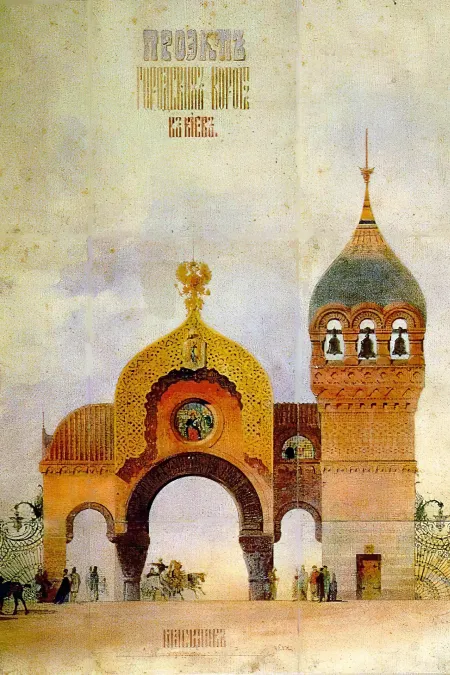
Das große Tor von Kiew, Viktor Hartmann
At the heart of the concert lies the Austrian premiere of Intensity, a highly charged orchestra work by composer Bernd Richard Deutsch. Combining formal clarity with emotional force, the piece condenses both into a gripping sonic experience while simultaneously reaching back into music history. One of its fundamental chords briefly reveals an echo of Modest Mussorgsky’s Pictures at an Exhibition—the very work that concludes the evening in Maurice Ravel’s brilliantly colorful orchestration.
Bernd Richard Deutsch is among the most distinctive and significant voices in contemporary music. Born in Austria in 1977, he studied bassoon and piano before pursuing music theory and composition at the University of Music and Performing Arts Vienna. His music captivates through its clear structures, yet never feels detached—rather, it is powerful, sensual, and deeply narrative.
Deutsch composes for leading orchestras and festivals around the world and has received numerous awards for his work. Characteristic of his creative process is his deliberate commitment to analog methods in an increasingly digital world: He records musical ideas in handwritten sketchbooks.
Intensity was composed in the United States during a period in which the composer felt personally isolated amid the COVID-19 pandemic. External stillness and inner tension permeated one another.
As associate fellow composer of The Cleveland Orchestra, Deutsch saw Intensity celebrating its premiere in January 2022 under music director Franz Welser-Möst. The work became a defining success for the Austrian composer. Rich in color, driven by energy, and emotionally intense, it combines explosive, powerful passages with quiet, introspective moments of remarkable virtuosity.

Impressionism in Music
The focus then shifts to Maurice Ravel, one of the greatest magicians of sound in music history. Often described as a perfectionist and a master orchestrator, Ravel understood music as an art of the finest gradations, radiant tone colors, and refined harmonies.
Suite No. 2 from Daphnis et Chloé is regarded as the epitome of his impressionist style. Conceived for the Ballets Russes, the ballet from which the suite is drawn emerged through close collaboration with figures such as Sergei Diaghilev and Vaslav Nijinsky. This creative tension both inspired and complicated the compositional process. Ravel himself described the work as a “vast musical fresco,” inspired by an idealized vision of ancient Greece. The opening of the suite in particular—the famous sunrise—unfolds a unique sonic magic: Shimmering woodwinds, floating strings, and the most subtle dynamic nuances bring nature audibly to life.
A New Creation and a Global Success
This ability to transform sound into image connects Ravel with both Deutsch and Mussorgsky. It is therefore fitting that Modest Mussorgsky’s Pictures at an Exhibition in Maurice Ravel’s orchestration forms the culmination of the program. Originally composed in 1874 as a piano cycle, the work pays tribute to Mussorgsky’s late friend, the St. Petersburg painter Viktor Hartmann. Through a series of musical miniatures, Hartmann’s images come alive—linked by the recurring “Promenade,” which guides listeners from one picture to the next.
In fact, it was only Ravel’s orchestration of 1922 that transformed the work into a worldwide success. With a distinct sense for tone colors, the French composer translated the often raw and archaic power of Mussorgsky’s piano writing into a dazzling orchestral palette. Each scene acquires its own sonic identity—from the plaintive alto saxophone of “Il vecchio castello – The Old Castle” to the mighty brass of “The Bogatyr Gates – The Great Gate of Kiev.” Ravel’s instrumentation is far more than a mere transcription—it is a new creation that bathes Mussorgsky’s musical language in a brilliant orchestral light.
Interwoven Perspectives
The program itself becomes an exhibition: Deutsch’s Intensity, contemporary in voice, born from the silence of isolation yet filled with inner motion; Ravel’s Daphnis et Chloé as an impressionistic play of light and color; and finally Mussorgsky’s Pictures at an Exhibition in the form Ravel bestowed upon it. Three works, three perspectives—connected by a subtle network of musical references spanning more than a century.

At the podium is Petr Popelka, a conductor celebrated for interpretations that are both energetic and finely nuanced. Since the 2024/25 season the chief conductor of the Wiener Symphoniker possesses a remarkable ability to shape musical arcs with sonic precision. Under his direction, this evening becomes an immersive journey through luminous soundscapes rich in visual imagination.
Petr Popelka
Wiener Symphoniker
10 August 2026 – 7.30 p.m.
Festspielhaus, Großer Saal

