


Interview by Anke Rauthmann
The text was published in issue 2 (3/26).
Reading time 4 Min.
“Close your eyes and immerse yourself”
For the first orchestra concert of the 2026 festival summer, Dalia Stasevska joins the Wiener Symphoniker to shape a richly varied program featuring sonorous works from different eras and countries. In this interview, the conductor speaks about musical influences, empathy, and the unifying power of music.

Dalia Stasevska, we are delighted to welcome you for the first time this summer as a conductor at the Bregenzer Festspiele. You are considered an inspiring musical voice of the younger generation. What are you most looking forward to as you prepare to conduct the Wiener Symphoniker?
Dalia Stasevska: I am especially looking forward to getting to know the musicians and to making music together with such an outstanding orchestra. When I was 20 years old, I spent a summer in Vienna as a violin student, and I still vividly remember attending a concert by the Wiener Symphoniker. Much time has passed since that summer, and it feels very special to return now in this new role.
Let us talk about the works you will conduct in Bregenz: You have selected a diverse program, with Antonín Dvořák’s famous Symphony No. 9 “From the New World” as its highlight. How do you approach this piece so that it feels modern and personal today?
Although this symphony is among the most frequently performed works, I am firmly convinced that great music always has something new to offer. Dvořák composed it with remarkable depth and feelings: grandeur and nostalgia, deeply intimate lyrical moments contrasted with rhythmic vitality, abundant hope and joy, as well as a sense of wonder and openness. This symphony is truly a force of nature!
Dvořák wove into this symphony the diverse cultural, ethnic, and even scenic impressions from his journey through the United States. You were born in Ukraine, spent your early childhood in Estonia, and later immigrated to Finland with your family. Does your personal multicultural background give you a particular connection to this work?
I consider it a great privilege to have grown up in multicultural and very different socioeconomic environments. Yes, I believe that my background strongly shapes how I experience music in general. Themes such as identity, distance, and belonging—carrying one’s roots within while at the same time discovering something new—resonate deeply with me.
For me, art is not only about sound or aesthetics—it stands for connection, humanity, and meaning.
Ciel d’hiver by the Finnish composer Kaija Saariaho, who passed away in 2023, is certainly a work that is especially close to you. It evokes a deeply wintery, almost meditative atmosphere. What kind of experience would you like to offer the audience as they listen?
When I conduct Ciel d’hiver, I do not imagine a concrete story or a specific image. Rather, I think of an atmosphere—of how one feels on a clear, cold night when looking up at the sky. I devote the greatest attention to the tonal colors—they are essential in Kaija’s music. This work always has a very strong effect on listeners, so my only advice is: Close your eyes and allow yourself to be carried away into the magical world that Kaija has created for us.
Lili Boulanger’s Faust et Hélène for orchestra, mezzo-soprano, tenor, and baritone provides a compelling contrast. Boulanger was only 19 years old when she became the first woman ever to win the prestigious Prix de Rome with this composition in 1913. Her music is rooted in late Romanticism and remarkably original, with an extraordinary range of colors and tensions—almost an opera in highly condensed, intense form. Yet Faust et Hélène is rarely performed. Why is that?
Lili Boulanger’s music is still comparatively “new” to a wider audience. She was an immensely talented and original composer, but also a woman—therefore the recognition she deserved came only later. Faust et Hélène is a fascinating work, and I am very much looking forward to working on it together with the Wiener Symphoniker!
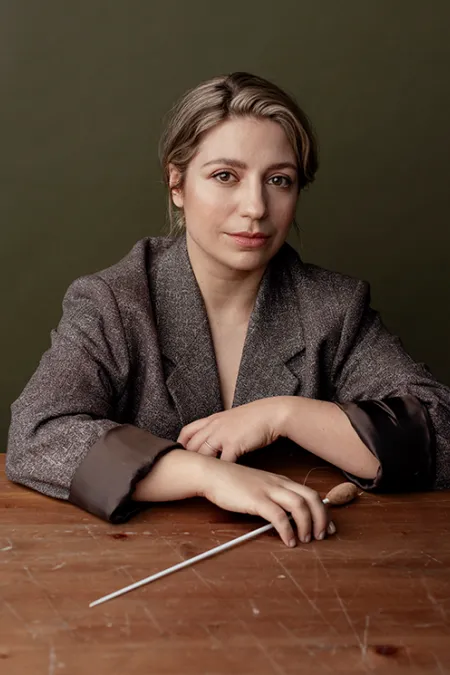
You are also active as an advocate for social change, solidarity, and democracy—in Finland, you were named “European of the Year” for your solidarity with the people of Ukraine. Can you describe what activism means to you and how it influences your artistic work?
For me, activism is something deeply personal. It arises from a sense of empathy and responsibility—I have a voice, so I should use it. Supporting Ukraine and standing up for human rights are not things that exist separately from my life or my work; they are part of who I am. For me, art is not only about sound or aesthetics—it stands for connection, humanity, and meaning.
Dalia Stasevska was born in Ukraine and grew up in Finland, where she initially studied violin and composition, later continuing with violin, viola, and conducting, at the Sibelius Academy, among others. She served as chief conductor of the Lahti Symphony Orchestra from 2021 to 2025 and as artistic director of the International Sibelius Festival. She is also principal guest conductor of the BBC Symphony Orchestra.

