


Interview by Anke Rauthmann
The text was published in issue 3 (6/26).
Reading time 6 Min.
“We’re Mixing Everything Up”
How do you turn a 194-year-old opera into a contemporary high school drama? With an unconventional take on Gaetano Donizetti’s L’elisir d’amore, acclaimed Finnish director Anna Kelo makes her debut in Bregenz. In this interview, she reveals what fascinates her about Gen Z, why directing was actually her last career choice—and why bel canto is both a blessing and a curse to her.
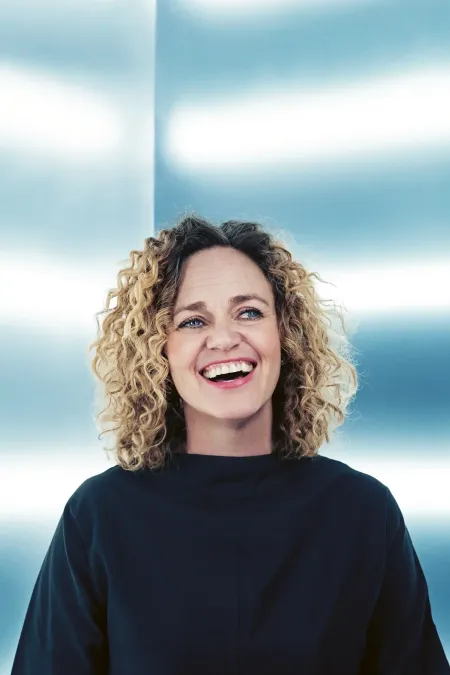
Ms. Kelo, you are staging Donizetti’s L’elisir d’amore as a coming-of-age story set in a high school. How does that transformation work?
Anna Kelo: Surprisingly well! The idea is to create a high school drama, the kind every generation has had—whether it was Grease in the 1970s or Sex Education on Netflix. That series was a huge stylistic inspiration for me: funny, confusing, touching, but also slightly awful and tragic, just as those years tend to be. And I find it fascinating to explore what defines the younger generation, are they Gen Y or Gen Z now? In any case, young people today can be whoever they want to be and love whoever they want to love, thank goodness. They do not have to identify with a specific gender or label. Does that make life easier or more complicated? That is the question, I do not know.

Are there any characters or scenes that you understand in a way that is completely different from the usual interpretation?
Yes, all of them! It is going to be a completely different story. We are mixing everything up. That also fits with the fact that we will not have a large choir. Our choir consists of just eleven people, each with their own role and their own name. The characters fall in love in every possible direction, hormones run wild—and will Adina and Nemorino really end up together in the end? We shall see!
How is that realized on stage? How do you create a high school atmosphere?
It is not a depressing high school with concrete walls, but a warm, cheerful one: realistic, yet also slightly exaggerated and playful. My wonderful stage and costume designer Tinde Lappalainen has created a very colorful world. The first act takes place in a schoolyard with a basketball hoop, while in the second act Adina hosts a party in her living room at home. And actually, I do not like using cell phones on stage very much, but when you are talking about young people today, there is no way around it. Everyone has one in their hand. There is even a couple whose entire relationship exists only through their phones.

Is that not all rather far removed from the Basque village of the early 19th century where the libretto is originally set?
To be honest, the story is a little silly. I do not think the most successful bel canto composers were necessarily the greatest dramaturges. The music is beautiful, but it does not carry the narrative with the same complexity you find in Puccini, Verdi, or Wagner. For a director, that creates freedom—because for me, music is always the most important thing, more important than the libretto, because you cannot fight against it. Whoever fights the music always loses. Donizetti’s music allows for many possibilities because it does not give clear instructions. When the idea for my concept first came to me, I listened to the opera, studied it, and asked myself: Is this possible? Can this work? And I quickly realized: yes, absolutely.
Is there a question you would like to ask Donizetti if you could invite him to a rehearsal?
Yes, why does everyone always have to sing the same thing over and over again? Goodness! All these arias and duets, it is like vocal acrobatics. It has nothing to do with the story or the text, it is simply about how many different coloraturas one can sing, almost like a sport or a circus act. Sometimes less would be more, if you ask me!
How do you deal with all those repetitions as a director?
I need more than just the music for something to move me. Through the production, I have to create a meaning for the music so that it makes sense to me. So that I understand why someone says the same thing twenty-seven times. I need to find a logic in it—for myself, for the performers, and ultimately for the audience. It is a process that will probably continue right up until the final rehearsal.
Whoever fights the music always loses.
L’elisir d’amore is a production featuring the young emerging talents of the Opera Studio. Did that influence your staging?
Yes, it is important to me that they have the opportunity to explore different ways of acting and performing. Not in the traditional operatic manner, but more as one would in film or television. I think that makes the experience interesting and perhaps motivating for the participants—and they are, after all, the main focus, more so than me and my concept.
Do you have any advice for the young singers that you wish you had known at the beginning of your own career?
That is difficult. The difference between generations is enormous, and the world has changed so much—what one is allowed to say and think, and what not…The problems I faced as a young artist were completely different from the challenges young people face today. Of course I could give them endless advice, but I do not think they should listen to it, they should ignore.

Did you already know as a teenager in school that you wanted to become an opera director one day?
Good heavens, never in my life! Anything but that! Both my parents are classical musicians—my father was a conductor and my mother is a pianist. I saw operas before I ever watched films. I grew up in that world; I’ve been steeped in it since birth. I wanted to break away! But I do not know what it is—maybe the genes—something pulled me back. Outside of my work, though, I still do not listen to opera or classical music in general, if I can avoid it.
What kind of music do you listen to instead in your free time?
I actually do not listen to that much music, especially not when I am working on a production, because then my head is already full. I am a Buddhist and also teach yoga and meditation, I like using music there. Every morning when I practice yoga, I listen to music. But it is ambient music - background music without actively listening to it.
With L’elisir d’amore, you are making your debut at the Bregenzer Festspiele. Have you been here before? Do you know Bregenz a little?
I came to Bregenz for the first time two years ago. I saw Der Freischütz on the Seebühne and Gianni Schicchi at Theater am Kornmarkt. And I swam in Lake Constance, the weather was beautiful, it was wonderful!
If you were to brew your own “elisir d’amore,” a love potion, what ingredients would you use?
Curiosity, empathy, and tolerance.
Anna Kelo studied at what is now the Russian Institute of Theatre Arts in Moscow and has been first assistant director at the Finnish National Opera since 1998. In the 2016/17 season, she supervised the stage direction of Götz Friedrich’s Der Ring des Nibelungen in Tokyo. Her own subsequent staging of the Ring tetralogy received international acclaim. Together with stage and costume designer Tinde Lappalainen, Anna Kelo is creating a youthful, colorful world for L’elisir d’amore.

