


Text by Jutta Berger
The text was published in issue 3 (6/26).
Reading time 1 Min.
"Technology Must Follow the Idea—Not the Other Way Around"
In La traviata, a gigantic mirror shatters, a sphere of fate hovers above the ill-fated Violetta, and a lavish party unfolds in a pool: How the technical team of the Bregenzer Festspiele brings stage designer Paolo Fantin’s ideas to life.

With Violetta, Giuseppe Verdi created an opera heroine who is both hungry for life and deeply conflicted. She sells her body to wealthy men, yet longs for true love. When she tries to live out her dream of a life together with Alfredo, reality catches up with her: Her fatal illness advances relentlessly. And the father of her beloved stands firmly against their relationship.
The key scene: Violetta looks into a mirror and sees her imminent death. The mirror falls to the ground and shatters. It is precisely this moment that stage designer Paolo Fantin wanted to capture in the production: “Violetta knows from the very beginning that she must die. In the mirror, she recognizes reality. As if in slow motion, the stage set captures the moment when the mirror touches the ground, just before it breaks. The ending can already be felt.”
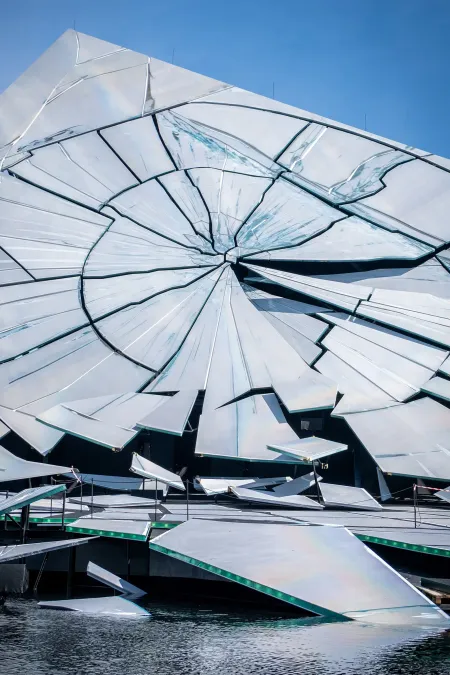
“It is incredible how the Bregenz team realized my idea,” says Fantin, paying tribute to the technical team of the Bregenzer Festspiele. After all, technology must always follow the idea—not the other way around. He never had any doubts. Ever since his student days at the Academy of Fine Arts in Venice, he has admired the Seebühne. During a student excursion to Bregenz, he realized: “This is not just theater—it is an idea.” An idea that does not simply combine nature, landscape, and opera, but places them in a dynamic artistic tension. “Because,” says Paolo Fantin, “theater and art thrive on tension, on contradictions.”
Testing, Discarding, Finding Solutions
“Sometimes we do become a little desperate when it comes to realizing artistic ideas,” technical director Wolfgang Urstadt says with a smile. During the four-year development period of a new production for the Seebühne, concepts are tested and discarded, then tested again—until a solution is finally found. That is how the metaphor of the shattered mirror gradually took shape on the Seebühne as a monumental structure. Alongside the experienced technical team of the Bregenzer Festspiele, 36 external companies are involved in creating the stage installation. Wolfgang Urstadt cites impressive figures: “The mirror wall covers an area of 700 square meters and, including the supporting steel structure, weighs around 195 tons.”
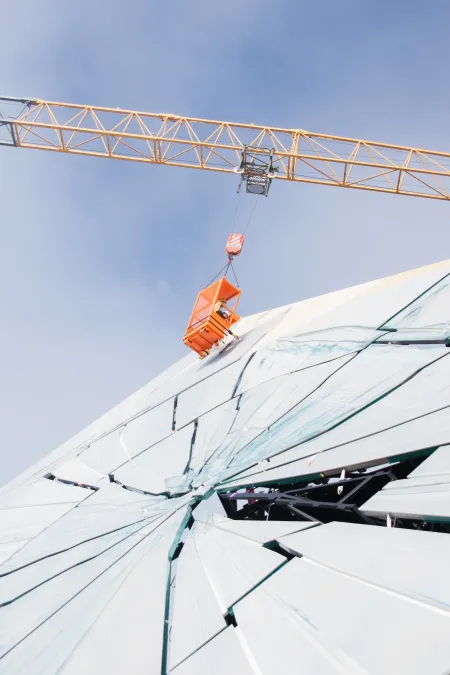
A total of 86 wooden shards, covered with plastic fabric that gives them the appearance of a mirror surface, rise up across the stage. Thanks to hydraulics, nearly half of them can move independently. The breaking of the mirror is depicted as an implosion. Urstadt explains: “The mirror breaks inward into twelve large sections. This is made possible through the centralized control of each individual element.” The programmed “movement,” as it is known in technical terminology, requires the utmost precision. “Every single shard must be controlled in such a way that no collisions occur, that no shard blocks the other.”
The implosion reveals another key element of the stage set. As if by magic, a gigantic black sphere appears, six meters in diameter and made of durable synthetic material. A sphere of fate? Interpretation is left open. Yet there is no magic behind the floating stage element—only solid mechanical engineering and reliable cable-car technology.
Intimate Moments on a Grand Stage
Director Damiano Michieletto and Paolo Fantin place La traviata in the Roaring Twenties—with glitter, glamour, and lavish celebrations. While Parisian society revels in excess, Violetta knows she no longer wants this superficial life. Fantin sees parallels with the present day: “We constantly want to present ourselves well, to look good, to be perfect. This superficial way of living is one of the weaknesses of our time.” People should focus more on what truly matters in life, the stage designer believes. This opera can help with that, “because it tells timeless stories. It builds a bridge between eras.”
The grand celebrations are brought to life spectacularly on the Seebühne: An infinity pool becomes a party location. To achieve this, the water basin created in 2024 for Der Freischütz between the stage and the seating area is transformed—and the guests enjoy themselves in the water. There is certainly enough room. At 1,400 square meters, the pool is larger than an Olympic swimming pool. The system is supplied with water from the lake, which is regularly renewed for hygiene reasons. Strict environmental and water protection standards are observed throughout the process, ensuring that only filtered, clean water is returned to the lake.
But how can the intimate, chamber-play-like moments of La traviata be made visible on such a vast scale? Through further ingenious stage details. The mirror wall allows seamless scene changes: It opens to reveal new spaces on two platforms. One, measuring around 60 square meters, becomes the setting for fragile private happiness. The other leads into a space where Violetta’s fate inevitably closes in on her ...

A Work of Art on Lake Constance
Experiencing La traviata live on the Seebühne this summer is reserved for those who secured tickets early—all others may wish to note 23 August: That is when the advance ticket sales of La traviata begin for the 2027 season. Until then, the scenery can already be admired during a walk by the lake. For stage designer Paolo Fantin, this is not merely a side effect but part of the concept itself: “When you design an outdoor stage set intended to remain in place for two years, it should not only withstand the weather—it should also be a work of art on the lake that everyone can enjoy.”

