


Text: Ingrid Lughofer
The text was published in issue 2 (3/26).
Reading time 4 Min.
Playing to the Point of Collapse
Contemporary language and yet à la Molière? The content unchanged and at the same time strikingly modern? The brisk wit of the original still at the core? In their adaptation of the comedy Le Malade imaginaire, the authors Barbara Sommer and Plinio Bachmann demonstrate how this can succeed.

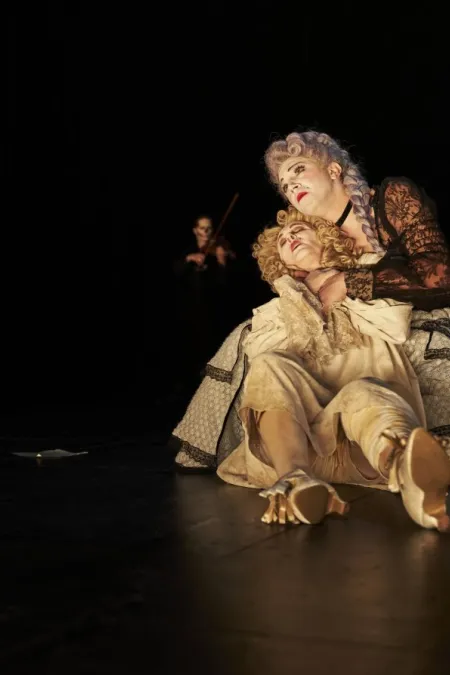
During the opening weekend of the festival, the Theater am Kornmarkt turns into a place of countless different artistic approaches: The Burgtheater brings Molière’s Le Malade imaginaire to the stage. The production originated in Cologne, where director Stefan Bachmann served as artistic director until 2024, and moved with him to the Burgtheater, where he now works as artistic director. On the list: exuberant, expressionistic playfulness, creative costumes, and a chaise longue that dominates the stage design. And actors who shine in sharply stylized, archetypal roles.
A Battle of Narratives
“Molière draws on stereotypes that still hold true today, yet their language no longer feels contemporary to us,” explains author Barbara Sommer, describing the impetus for the new version. The writing duo, who are also a couple in real life, remained close to the original text and its dramaturgical structure, while modernizing the characters. “We asked ourselves who these crudely drawn Commedia dell’arte figures might be today, and found contemporary equivalents, which we then sharpened linguistically.”
The plot in brief: The hypochondriac Argan feels dependent on his doctor’s treatments and therefore wants his daughter Angélique to marry a physician. But she loves Cléante. Her stepmother Béline is waiting for her inheritance, while Argan’s brother Béralde has plenty of advice at hand. And then there is the maid Toinette, who stands at the center: “She operates like a kind of director, wielding great manipulative power, exploiting the fact that everyone is so caught up with their own lives.
In doing so, Sommer touches on the core theme: “The characters form a dysfunctional family. There is no shared reality anymore; each character pursues only their own interests. On a small scale, this reflects present social developments.” Bachmann adds: “It is a battle of narratives. The current President of the United States demonstrates daily that it is no longer about telling the truth, but simply about firing off one’s own narrative.”

Language as Weapon and Mask
That is precisely how the exaggerated, almost caricature-like characters operate, each expressing themselves in a distinct linguistic register. “Angélique uses her hypersensitivity as a weapon, Cléante turns his ‘woke’ language destructively against himself. Béralde, who in Molière is the voice of reason, becomes a conspiracy theorist on the right-esoteric fringe, and Argan terrorizes everyone with his rhetoric of victimhood. It is a current tactic to stage oneself as a victim in order to gain power and influence,” says Bachmann. Only Toinette, like a chameleon, adopts the speech patterns of the others in order to provoke the desired response.
Molière, who wrote his final play Le Malade imaginaire in 1673, took inspiration from Louis XIV, the “Sun King,” who throughout his life was subjected to the tortures of his physicians. In the Viennese version, too, Argan’s doctors are primarily concerned with promising therapeutic success in exchange for high fees, while the diagnosis itself remains entirely interchangeable.
The comic mechanics in Molière function like a Swiss clockwork,” Bachmann says, fascinated by the clownish elements: “Argan pretends to be dead, and suddenly shouts: ‘Hello, I am still alive!’” Humor and situational comedy are ever-present, and since Argan constantly undergoes rectal enemas, scatological wordplay is close at hand. The cross-gender casting adds an extra layer of humor to certain punchlines.
Theater is balm for the bowels!
Friction and a Meta-Level
“While writing, we only knew that Argan would be played by a woman. For us, that is secondary—the frictions between the characters are what matter.” The two form a well-practiced writing duo, tossing ideas back and forth like a game of ping-pong during their adaptation of Molière, and valuing the feedback of Stefan Bachmann and dramaturge Thomas Jonigk.
The language remains baroque, playful, and witty. “Yet as humorous as the play is, the theme of death is always present,” Sommer notes, pointing to Argan’s constant anxieties. In reality, however, it was Molière himself who died: During the original run in 1673, he played the title role while gravely ill, suffered a hemorrhage on stage during the fourth performance, and died only a few hours later, still in costume.
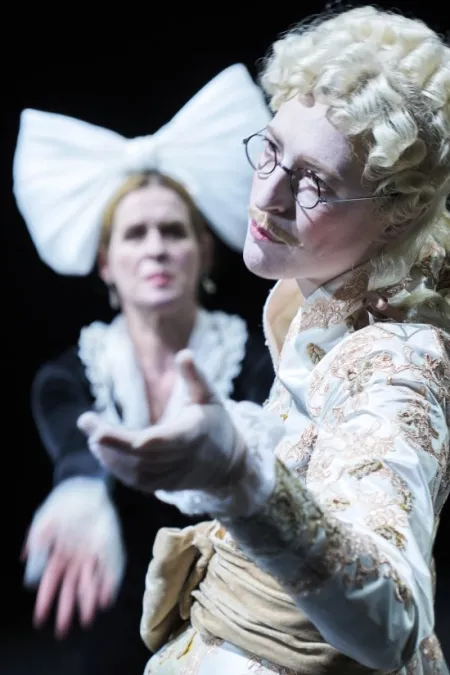
Just as Molière already framed the play as theater within the theater, Sommer and Bachmann also incorporate a meta-level, having Argan say: “And how do you explain that Molière himself, while playing me, dropped dead on stage? … I want to survive this play! Do you understand? … Let us simply finish it.”
But what will the ending be? Will Argan remain completely deluded and estranged from reality, or will he become a self-healing doctor, finding happiness in the endless cycle of his own digestion? The answer will be revealed at the premiere on 24 July at the Theater am Kornmarkt.
Le Malade imaginaire
Molière
24 July 2026 – 7.30 p.m. Premiere
Theater am Kornmarkt
