


Interview by Anke Rauthmann
The text was published in issue 2 (3/26).
Reading time 5 Min.
Ahead of His Time …
Leoš Janáček’s opera The Excursions of Mr. Brouček ranks among the most original operas of the 20th century. Beneath its surreal, burlesque surface it captures the spirit of its time—and asks the unsettling question of where we are actually headed. The US-American director Yuval Sharon—celebrated by The New York Times as “the most visionary opera director of his generation”—brings Janáček’s extraordinary work to the great stage of the Festspielhaus in a new production. Dramaturge Anke Rauthmann speaks with him about his directorial approach.

You have a very special connection to the Bregenzer Festspiele. At the start of your career, you worked as assistant director to Graham Vick on Aida at the Seebühne in 2009/10. What do you associate with Bregenz—was there a key moment?
Yuval Sharon: I still vividly remember the stage design of Un ballo in maschera in 1999—this skeleton that seemed to rise out of the water with a giant book and all those tiny human figures. At the time, I was studying in Berkeley and felt more connected to film and theater than to opera, which I considered a bit old-fashioned. Then I saw this image from Bregenz in the press and thought: “Oh my God, this really exists?!” It was the reason why I decided to spend a year studying in Europe, returning with a completely new perspective on music theater, because I realized that opera can offer both: grand imagery, metaphor, abstraction—and emotion, depth, identification.
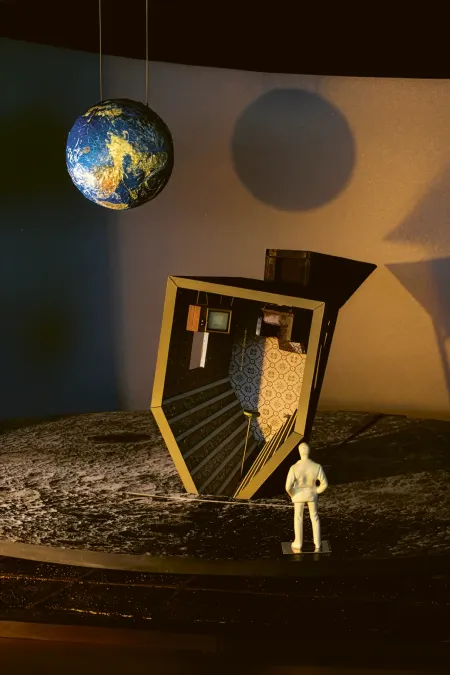
A perfect transition to Janáček’s The Excursions of Mr. Brouček, which combines biting social critique with deep humanity: Matěj Brouček, who was born in Prague, loves nothing more than his peace and a good beer, and is unwillingly sent on a wildly absurd journey. He first finds himself on the moon and then, back on Earth, in the 15th century. How did you approach such a work?
We wanted the production to have something wondrous about it, and we drew strong inspiration from Czech Dadaism and the Theater of the Absurd. Brouček, a typical petit bourgeois, encounters an irrational world—yet his mind does not open to it. And that is exactly what Janáček criticizes: this self-satisfied narrow-mindedness, this attitude of “I already know everything.” But instead of merely mocking such people, Janáček shows that we all live within our own small comfort zones. And when confronted with something unfamiliar, we withdraw rather than remain curious. Could we not be more open-minded, more courageous, more receptive?
The opera is composed in two parts, which are very different and were written ten years apart …
The first part is shaped by Janáček’s warm-hearted and highly original humor: Brouček is simply catapulted to the moon! It is fantastic, childlike, and stands in complete contrast to the heaviness of many operas of that time. And yet the music is highly complex and full of nuance. In this respect, Janáček resembles Mozart: seemingly light—but in truth profound and demanding. The composition reveals an overwhelming musical richness. One can simply let oneself be carried along: by wonder, by play, by joy. We want to take our audience along on this wild ride!
In the second act, however, the tone shifts: Matěj Brouček no longer encounters extraterrestrials but the past of his own country. And what is unsettling is that, although he meets people from his own history, they seem even more foreign to him than the beings from the moon. They are his people, embodying his own roots—yet they mean nothing to him. These figures represent ideals he does not understand and cannot access.

In collaboration with the award-winning London-based stage and costume designer Jon Bausor, the production promises to be visually striking as well. A central image is a box. A symbol of the bubble in which we live?
Whether we call it a bubble or a box—we build walls around us and make ourselves comfortable in our own world. But that is precisely what limits us. We impose explanations on the new and the unknown because our imagination is so limited. Janáček observes this and shows us our weaknesses—not cynically, but with great humanity and compassion.
When we stop being curious about the world, or when we no longer search for our roots or our past, we begin to die inside. And that is exactly what makes this opera so relevant today. Brouček has lost his connection to his own history. All the generations before him lived, struggled, fought—so that someone like him could eat and drink in peace. And he does not care. That is tragic!
In German, there is a powerful word for this: “geschichtsvergessen” (historically oblivious).
That captures it exactly. Because anyone who forgets their history strips all those who came before them of their dignity. And Janáček conveys this important message with lightness and humor, and at the same time with great depth. It begins with Dada and burlesque absurdity, but in the second part the music becomes stirring and leads us to a profoundly moving place.
When we stop being curious about the world or searching for our roots, we begin to die inside.
Today, we increasingly see this historical amnesia in societal trends … was Janáček, then, a visionary?
I believe that at a certain point, the central theme of all his operas becomes the limitation of human perception. In this respect, Brouček marks a turning point in Janáček’s compositional work. After it, he wrote The Cunning Little Vixen, The Makropulos Case, and From the House of the Dead in quick succession—works that all engage with the world beyond our narrow perspective.
And perhaps that is opera’s greatest strength: That it can help us look beyond the limits of our own perception.

US-American director Yuval Sharon is currently staging Wagner’s Tristan und Isolde at the Metropolitan Opera in New York. As founder of the Los Angeles-based theater company The Industry, Sharon has staged and produced new operas in moving vehicles, active train stations, and a wide range of “non-places.” He is artistic director of Detroit Opera and has also made a name for himself as an author with A New Philosophy of Opera. In the summer of 2026, he will direct at the Bregenzer Festspiele for the first time.
The Excursions of Mr. Brouček
Leoš Janáček
23 July 2026 – 7.30 p.m. Premiere
Festspielhaus, Großer Saal

