


Text: Kathrin Grabher
The text was published in issue 2 (3/26).
Reading time 5 Min.
80 Years of New Ground
From the very beginning, the Bregenzer Festspiele have been a place of curiosity, enthusiasm, and bold ideas. This summer, the festival celebrates its 80th anniversary—an occasion to look back at the architectural history of its most iconic landmark: the Seebühne.
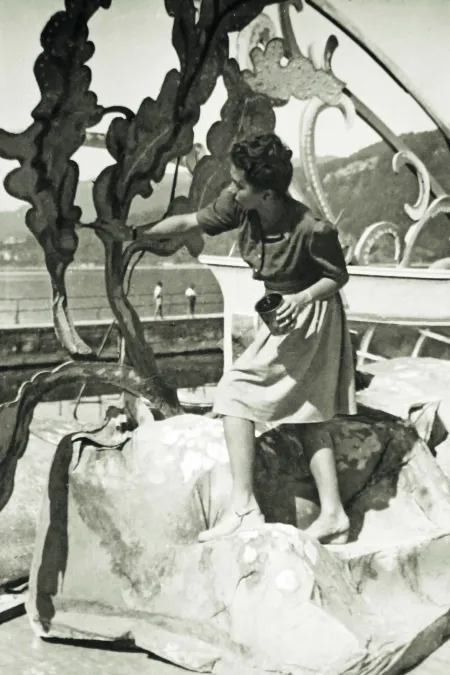
Maria Wanda Milliore, 1946
1946 – The Art of Improvisation
In essence, the original spark has endured to this day: Great ideas come first—their realization will follow. In the beginning, two gravel barges are chained together to form the Seebühne; craftsmen build a platform on top using wooden beams from the old granary. Yet the prototype does not last long. A storm tears the stage apart.
On the second attempt, the barges are separated: One becomes the stage; the smaller one, positioned in front, serves as the orchestra pit. Stage designer Maria Wanda Milliore, who had fled from Vienna to Vorarlberg, takes on the design. The stage’s showpiece is an arch lined with light bulbs, which—despite all doubts—endured for the entire season.
Benches and barrels—loaned by inns and breweries—are arranged along the shore as seating rows. On them, more than 8,000 people over two evenings listen to the first Opera at the Lake: Mozart’s Bastien und Bastienne.

Bastien und Bastienne, 1946
1947 – Culture at Public Swimming Pool
Following great success and a financial surplus of nearly 4,000 schillings, the festival continues in 1947. The new Seebühne is built on piles at the public swimming pool. Alongside the skeptical glances of some bathers, the location offers practical advantages: dressing rooms for the performers and controlled access during rehearsals and construction work.
Two years later, the “Deuring auditorium,” named after its benefactor and offering around 5,000 seats, is built here. The location remains controversial: Opponents speak of disfiguring the shoreline, while supporters criticize the water quality of the public swimming pool—which, in any case, they argue, speaks more for a festival venue than for a public swimming area…
I had my doubts from the start whether it would hold in rough water conditions, but the gentlemen insisted that it would.
1950 – Where to Put the Audience?
Eventually, the Seebühne, together with its outdoor auditorium, moves to a nearby open site. Yet by 1951, with the overwhelming success of Strauss’s operetta Der Zigeunerbaron—on one single evening, the city police count more than 1,000 cars, 82 motorcycles, and 140 bicycles—it becomes clear that the space is insufficient. The following year, a massive gravel embankment creates an amphitheater with 6,700 seats, the festival’s permanent home for more than two decades.
By now, the Seebühne consists of several permanently anchored islands as well as floating elements that can be moved by underwater cable systems. Year after year, they are adapted and expanded according to the scenic concept.

Der Vogelhändler, 1952
The 1950s – A Voyage of Discovery on the Lake
The 1950s are marked by artistic ingenuity and a spirit of technical experimentation. Productions grow more elaborate; the fire brigade assists in creating water features and fountains.
Der Vogelhändler in 1952 introduces deliberately exaggerated proportions for the first time: The orchestra takes its place inside a giant opening shell. However, the fountains are positioned too close to the audience—resulting in an unintended shower.
In 1957, an autonomously moving ship becomes the star of Zar und Zimmermann. Accompanied by spectacular Bengal lights, Tsar Peter the Great sails out onto the lake. The ship is reused in subsequent productions. Director Adolf Rott calculates that it is larger than the “Santa Maria” with which Columbus discovered America.
In 1958, with Die verkaufte Braut, an opera returns to the program for the second consecutive year. Real acrobats appear in the circus scene, and the matchmaker Kezal is thrown into the water to the audience’s delight—the stunt is performed by an extra. Yet the production is not successful, and the festival returns to operetta. In 1959, Tausendundeine Nacht introduces a water curtain as a projection surface—a premiere for water effects as scenic elements in stage design.

Tausendundeine Nacht, 1959
1965 – A Technical Marvel
Just two weeks before rehearsals begin for Eine Nacht in Venedig, disaster strikes: The Seebühne is completely destroyed by storm and flooding. In an extraordinary effort, it is rebuilt and raised by one and a half meters.
By now, the stage, including the playable water areas, covers around 40,000 square meters. More than 4,000 cubic meters of wood are used, along with 1,500 square meters of fiberboard, plastic sheeting, and fabric cladding. Especially during rehearsals, these dimensions require effective communication. By 1967, there are 25 telephones, 9 intercom systems, 10 two-way radios—and, when all else fails, a megaphone. An acoustic enhancement system ensures good sound for the audience. The rumor that all the stage pumps once failed because they had sucked in every fish from Lake Constance is dismissed by the technical director as pure myth.
1978 – The Beginning of a New Era
On 19 August 1978, the final performance takes place at the old festival grounds—the construction of the Festspielhaus begins. As early as 1979, Turandot is staged on the new Seebühne, and the building opens in July 1980. The modern infrastructure, particularly in the lighting departments, creates new possibilities for productions on the lake. At the heart of the stage, the orchestra is given a weather-protected space, while sound transmission is continually refined.
1985 – Two Is Better Than One
With Die Zauberflöte in 1985, the interplay of technology, nature, and theater reaches its full potential—at a considerable cost. The leading team demands new technical resources for its concept, including a mixing console for computer-controlled directional sound localization and a cable car to let the three boys float above the audience. The spectacular construction site on the lake sparks great curiosity—by the end of April, ticket sales are already 47 percent higher than the previous year.
Die Zauberflöte becomes a resounding success. For this reason—and to reduce costs—the production is scheduled again the following year, marking the beginning of the two-year cycle on the Seebühne.
To be continued…
How the story continues over the next 40 years—with riding toreros, British secret agents, and elemental clothespins—will be revealed in June in the next issue of the Festspielzeit magazine.