


Text by Babette Karner
The text was published in Edition 1 (11/25).
Reading time 4 Min.
Letters and Flowers: Three Days between Film and Stage
In a studio on the edge of the Wienerwald (Vienna Woods), film scenes for La traviata are being shot over the course of three days—images that, in summer, will become part of the production on the Seebühne. Day two of filming offers a glimpse of stage reality where opera meets film.
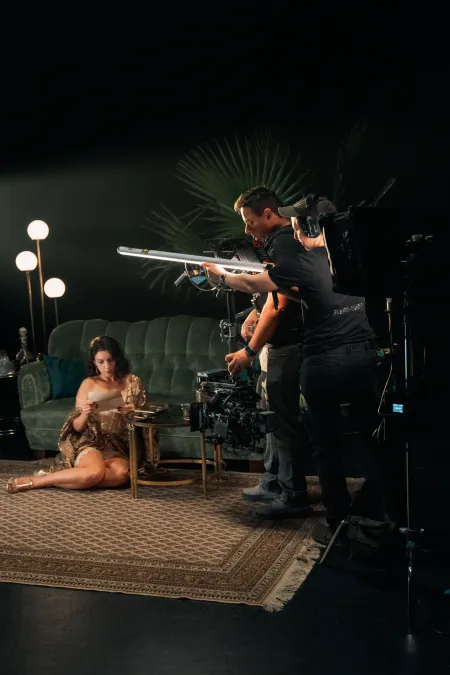
In the small town Tullnerbach, nestled among hills and family homes, where birds outvoice the passing cars you find the film studio of “Vienna Sound Vienna Light.”
Over the course of three days key scenes from the life of Violetta Valéry are shot here in October—footage that later becomes part of the production of La traviata on the Seebühne of the Bregenzer Festspiele. The set is a rare encounter of two art forms—theater and film, two working methods that must intertwine: The film’s love for precision and the theater’s mindset of “everything has to work live.”
The shoot was organized by the production company studio draussen, based in Vienna and is represented by CEO and executive producer Christoph Schramm and general manager Robin Uthe. “Normally we shoot TV commercials. We prepare everything meticulously for weeks—and on shooting day, every detail has to be spot on,” says Robin. Here, however, some things are a little more flexible: “Sometimes the decision about which prop we actually need is made in the moment.” Light and video designer Roland Horvath, who is originally from Graz, acts as a link between the worlds of film and opera. He is responsible for the lighting design and video production for La traviata. Stage director on the Seebühne is Damiano Michieletto.
Shortly before 9:30 a.m., nearly thirty people bustle through the studio: Set designers from the film team and the opera, lighting, costume and make-up crews, director Damiano Michieletto and the actors. Props are placed, spotlights and monitors adjusted, and a large palm tree is pushed in from the courtyard.
Several sets have been built—a sofa corner, a bed draped in a golden coverlet, Violetta’s dressing table with an opulent bouquet of real pink lilies.
Production management is in the hands of assistant director Marie-Therese Hildenbrandt. She brings art and technology together. Equipped with a headset, calm precision and great patience, she coordinates everything and maintains the overview. Today, on the second shooting day, everything revolves around letters: Violetta’s farewell letter to Alfredo, which she writes at the command of his father Giorgio Germont, and Germont’s letter in which he later asks for her forgiveness.
Violetta—portrayed by Katharina Pizzera for the film scenes—sits on a dark green velvet sofa in a negligee. She tears up a letter, sets it on fire. The live camera feed is projected in real time onto a screen showing the model of the La traviata stage on Lake Constance. This allows the team to see how the scene will later appear as a large-scale projection on the Seebühne. “It makes it so much easier to imagine the final result,” says head of the art department Susanna Boehm. Together with Damiano Michieletto and Roland Horvath, she watches the scene on the monitor. “Giuseppe, further right! No, not that far!” Damiano calls. Director of photography Giuseppe Torcaso carries his Steadicam like futuristic armor and patiently repeats each take until everyone is satisfied. In between, Bea John from the Bregenzer Festspiele make-up department refreshes Violetta’s make-up, and Gianluca Cataldo, assistant of La traviata set designer Paolo Fantin, rearranges the props on the coffee table. Should the whiskey carafe stay or go? “If we take it away now, we have to discard everything we’ve already shot,” warns Roland Horvath. But Damiano doesn’t like the bottle. Marie-Therese mediates; the whiskey stays.
Meanwhile, Violetta tears up the third letter. She is supposed to ignite the scraps in a small bowl, but the lighter refuses to work. Laughter. “Focus, please,” calls Marie-Therese, “we don’t have unlimited letters!”
For twenty minutes the actress has been sitting on the velvet sofa, with her legs crossed one might wonder if they’ve fallen asleep by now. Actors not only need talent but also a lot of patience. And strong limbs. “Faster, more natural!” Damiano calls, as Violetta tears up the fourth letter. One more time.
Make-up artist Bea John has spent the past 25 summers working at the Bregenzer Festspiele. Throughout the year, she works on film productions in Berlin. A stroke of luck. She knows the routines—and the cues. Violetta’s make-up needs her attention once again before the actress tears up the fifth letter. Or is it already the sixth? “Cut!” Damiano shouts.
Lenka Radecky, head of the Bregenzer Festspiele costume department, organizes the actors’ wardrobe together with her team and La traviata costume designer Carla Teti. “They are the original costumes of our Seebühne production.” Robes as well as lace-and-silk negligees in the style of the 1920s hang on long clothing racks in the improvised costume stock. A colleague carefully packs the feather boas which were used in yesterday’s filming. Three sewing machines are ready for adjustments and repairs.
Everything is ready for the next scene. Wearing an elegant morning robe, Violetta sits at her dressing table; a vase of pink lilies is reflected in the mirror, the light is dimmed. “Focus first on her, then on the mirror,” says Roland Horvath. The contrast between the delicate Violetta in yellow silk and Steadicam operator Giuseppe, dressed entirely in black with the heavy rig strapped to his waist and shoulders, could hardly be greater. “Roll camera,” shouts Marie-Therese, then: “Shhhh!” Someone has bumped into a chair in the dark. Back to the start.
In the afternoon, the shooting schedule reads: “Smash mirror.” The set designer mounts an unbreakable plexiglass mirror on Violetta’s dressing table. Damiano explains the scene to Caner Demirbag, who plays Alfredo in a white suit with his wavy hair slicked back. “You’re furious and desperate because Violetta has left you. So, you destroy her vanity mirror—her personal sphere.”
“Go!” Damiano calls, and Alfredo rushes toward the mirror, throwing aside the pink lilies. “Go!” Damiano calls again, and the vase flies off the table. On the third “Go!” Alfredo hurls the golden box at the mirror with verve. “Cut!” calls Marie-Therese. “Good,” says Damiano, “again.” Alfredo swings back and strikes with full force—leaving a small mark on the plexiglass. Damiano nods with satisfaction. Gianluca clears the flowers and brings a fresh bouquet. The sweet, heavy scent of lilies lingers in the air.
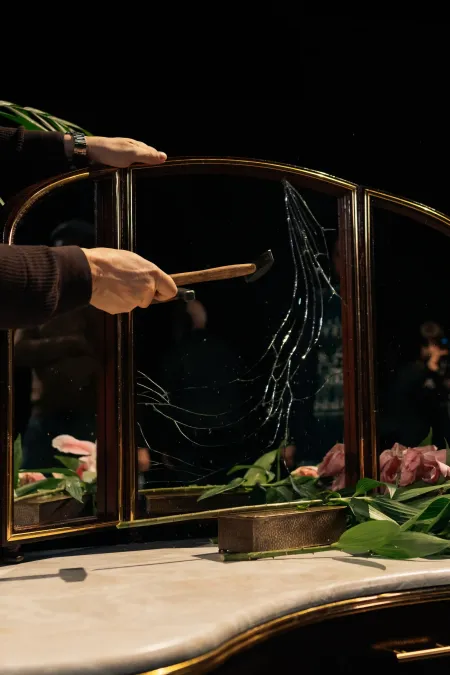
Damiano Michieletto takes up the hammer—smashing the mirror is a job for the boss.
Now the real mirror is affixed onto the vanity. Damiano Michieletto himself takes the hammer—smashing the mirror is a job for the boss. Ships are christened with champagne bottles; the Bregenzer La traviata is christened with a small hammer. Three blows, then the look is spot-on. Now it’s Alfredo’s turn again: The box hits the already shattered mirror. The camera stays on his face; the desperate cry he lets out is sending chills through the people standing around. “Thank you, very nice.”
The day draws to a close with one last rehearsal for the next scene. Outside, twilight settles over the Wienerwald, and eventually someone says: “That’s it for today.” Three days of film, three days of opera, many worlds under one roof. The story continues tomorrow.

