


Interview by Viola Bierich
The text was published in issue 3 (6/26).
Reading time 5 Min.
“If the music is good and I can sing it, I do it!“
This summer, you can experience the internationally acclaimed mezzo-soprano Anne Sofie von Otter in two productions: in the world premiere of Passion of the Common Man at the Werkstattbühne and in her chanson recital Douce France at Theater am Kornmarkt.

Passion of the Common Man is the work of Icelandic composer Daníel Bjarnason and Canadian librettist Royce Vavrek. Over recent years, you have already appeared in two operas for which Vavrek also wrote the libretti. What distinguishes his texts?
Anne Sofie von Otter: Royce is a brilliant librettist—no wonder he receives so many commissions! His texts are a clever blend of contemporary everyday language and poetic turns of phrase that create vivid imagery. His words do not only linger in the mind, they also sit beautifully on the tongue, while carrying that certain something—a grandeur of style, one might say—that makes you listen more closely. Accessible, but with a twist.
Royce clearly loves what he does and is always fully invested. When we rehearsed his operas Melancholia and Fanny and Alexander, he did not miss a single rehearsal.
Are there differences for you in working on a world premiere compared to a repertoire work?
With a world premiere, nobody knows at the beginning what the music will truly sound like, not even the composer. The work exists only as lines and dots on a sheet of paper, until we—the performers—begin filling in the empty spaces with color, just as if it were a coloring book. It is an incredibly free and exciting process. But it can also feel disorienting, because the music only gradually takes shape.
Passion of the Common Man is based on the Passions of Johann Sebastian Bach. Where do you see the potential of this musical form?
In Bach’s Passions, there are recitatives that drive the plot forward, the choir that comments and is at times deeply involved, and arias that express emotions and moods. That is very much what Daníel has written as well: There is a kind of narrator—that will be me—and three further roles. The choir listens and comments, sometimes joins in, and underscores what is being said. Out of this emerges a dramatic and varied whole, built upon a fundamental structure that allows for storytelling that is both effective and direct.
Passion of the Common Man addresses empathy in a secular context. Your role guides the audience through the narrative. How do you prepare for such a part? Is it a stage character you immerse yourself in psychologically, or more an instance that maintains a certain distance?
My role is certainly conceived in a very formal way and possesses a certain sharpness, yet I think she still has her own investment in what the piece is trying to convey. I regard text and music as a unity; the first and most important filter through which a work passes is that of the composer. Tempo, intervals, range, dynamics—all of this has already been determined, and my task is to decipher this information and fill it with my own personality. Later, the director enters the process with creative ideas—in our case Netia Jones. I trust her work completely, and she will make many important decisions, including how much distance I maintain in portraying my role.
Working with music inspires me, challenges me, stimulates me: my mind, my heart, and my soul.
Your career is marked by remarkable versatility. Has what you seek in your work changed over time, or are there guiding principles that remain constant?
Working with music and interpreting it is my life. It inspires me, challenges me, stimulates me: my mind, my heart, and my soul. I remain deeply grateful that I found my path in it, and I know I will never tire of it. I do not really have guiding principles, apart from hard work, a great deal of practice, and the precise study of my roles in order to reach what lies within them and what I can make of them. It is about musical imagination and absolute focus. A project becomes especially delightful when I sense that my colleagues share the same approach.
Throughout your career, you have repeatedly stepped beyond classical music. In Bregenz, you will present your chanson recital Douce France, spanning French chansons, Berlin songs, and Swedish folk music. What draws you to working across genres?
The answer is simple: If the music is good and I can sing it, I do it! The Berlin songs and French chansons date from the 1930s to the 1950s. Their composers were often classically trained, and the musical language is extraordinarily varied and original. The vocal lines are great fun, and the texts are highly entertaining—at times deeply profound. It was most certainly a golden age of popular music!
Finally, what are you looking forward to in Bregenz?
I hope I will find time alongside work to visit the Bregenzerwald. I have sung several times in Schwarzenberg at the Schubertiade in the past, and the landscape there is simply breathtaking. I love hiking, and on beautiful days, a swim in an ice-cold river is exactly the right thing! I am also looking forward to experiencing the sunset over Lake Constance while sipping a delicious cocktail!
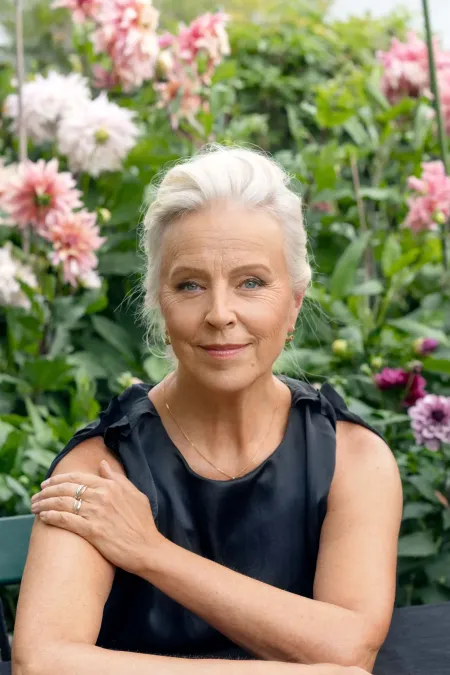
Anne Sofie von Otter is one of the leading mezzo-sopranos of our time. Born in Stockholm, her career has regularly taken her to the world’s most renowned stages. With remarkable stylistic versatility, she bridges opera, song, and contemporary projects, collaborating with artists around the globe. In 2015, Douce France received the Grammy Award for Best Classical Solo Vocal Album.

