


Interview by Anke Rauthmann.
The text was published in Edition 1 (11/25).
Reading time 4 Min.
Grown in Friendship
Since their founding, the Bregenzer Festspiele have been shaped by dedicated and passionate individuals. Among them are the members of the Friends of the Bregenzer Festspiele, chaired by Judith Salzmann. In this interview, she speaks about the association’s significance, its origins, and its enthusiasm for artistic challenges.

What exactly are the Friends of the Bregenzer Festspiele?
Judith Salzmann: We see ourselves as an integral part of the Festspiele—not as an external sponsor. After World War II, citizens from Bregenz and the surrounding region organized the first Festspiele production themselves. In 1946 Mozart’s Bastien und Bastienne was performed on two barges. From this endeavor, our association emerged, supporting the Festspiele independently up until 1989 when the GmbH (limited liability company) and later the foundation were established, in which we still hold a 40 percent stake today.
And who are the “Friends” today?
People from all over the Lake Constance region—from Bregenz, Vorarlberg, Germany, Switzerland, and even Vienna. We all share a passion for the Festspiele and support its growth. 80 years of the Bregenzer Festspiele is, of course, a success story we are proud to be part of. We are particularly excited about the new impulses brought by artistic director Lilli Paasikivi, which are already noticeable and will continue to grow.
Who typically participates in the ”Verein der Freunde der Bregenzer Festspiele“?
It’s a cross-section of society and professions. Culture is not an elitist matter. Among the Cercle members and Patrons are many who contribute out of inner conviction and the wish to point out the importance of culture to politics and society. Some do so very visibly, others quietly. We also aim to encourage young people to support the Festspiele—membership is free up to the age of 26. Beyond that, memberships range from EUR 75 per year up to EUR 2,000 for the Cercle, making participation accessible to everyone.
You mentioned the 80th anniversary of the Festspiele. In August, there will be the Singalong at the Lake, a communal singing event on the Seebühne. The theme is the Latin phrase “Alemania cantat”, also inscribed on a cornerstone of the Festspielhaus. What does it signify?
"The Alemanni sing"—but it’s not just about singing. It reflects the region’s special cultural ethos. Monasteries, music associations, choirs, and music schools—the density is remarkable. Even in small valleys, music thrives. That shapes who we are.
The Festspiele’s “Orchestra in Residence” comes from Vienna: The Wiener Symphoniker have been part of the Festspiele from the very beginning. How did that come about?
Legend has it that in 1946, they came mainly for the good food and cognac. Vorarlberg was under French occupation, while Vienna faced supply issues under Russian occupation. Over time, a genuine friendship has developed. Many musicians have been coming for decades and feel at home here. This connection has also helped to break down prejudices between Vienna and Vorarlberg.
The association also provides significant financial support to the Bregenzer Festspiele…
Yes, we contribute over EUR 300,000 annually and are thus the festival’s largest individual sponsor. Additionally, we have a special fund for the artistic direction, supporting projects that might otherwise be impossible to stage. Thanks to this fund, the experimental production YUM! can be realized on the Werkstattbühne. Especially in times of budget cuts, such funds are essential.

What do members get in return?
Many exclusive insights—invitations to program presentations or masterclasses, for example. Particularly popular is the Opening of the Bregenzer Festspiele: Half of the free tickets go to our members, the other half to guests from politics, economics, and culture. Cercle members and Patrons have guaranteed access. For others, a registration process ensures that nearly everyone has a chance to participate.
Why is cultural sponsorship so important today?
Because culture is often the first area to face cuts in times of crisis. For us, it is part of our identity—perhaps not for every individual citizen of Bregenz, but on average. That the Federal President speaks to all citizens at the Opening, not just in front of VIPs, sends a strong signal.
What is particularly important to the Friends of the Bregenzer Festspiele in terms of content?
Of course, we love the Opera at the Lake and the Opera in the Festspielhaus—but we are also fascinated by what happens beyond that: The Opera Studio, the Werkstattbühne… new, experimental productions that often cannot be realized in traditional repertoire houses. Likewise, the excellent guest performances by renowned ensembles such as the Burgtheater are a huge enrichment and part of the festival experience for us. Diversity, variety, and high quality—even in niches—are important to us.
Do you also influence the festival’s program?
No. That is clearly the responsibility of the artistic direction. We do not set themes. But we wish for diversity—and for the Festspiele to be daring. We want to be challenged by progressive and innovative performances that do not only delight but also provoke thought.
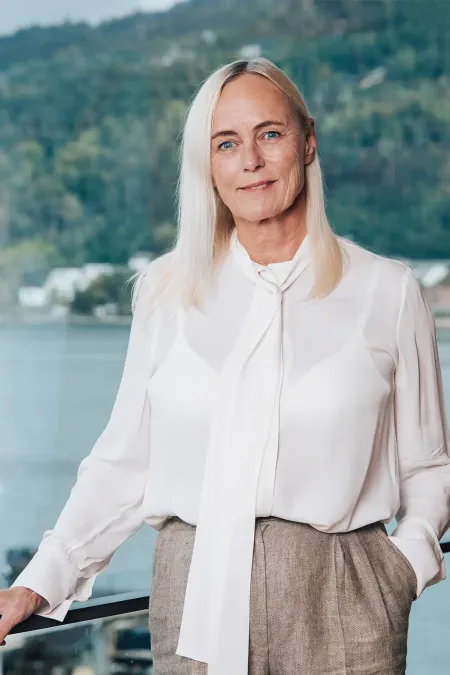
Judith Salzmann has been Head of the “Verein der Freunde der Bregenzer Festspiele“ (Friends of the Bregenzer Festspiele) for four years. The association was founded in 1949 as the Festspielgemeinde Bregenz (Bregenz Festival Society). Back then, on the Seebühne: Johann Strauss’ Tausendundeine Nacht.
Which opera would you like to see on the lake?
I am very much looking forward to La Traviata—it has never been performed on the Seebühne. I also love The Magic Flute, which we had twice. But fundamentally, I trust the artistic direction. We only support—but artistic decisions are made by others.
Finally: Do you also see yourselves as mediators or even motivators?
Absolutely! Our most important task is to pass on our enthusiasm to the next generation. The founding idea of 1946—culture as an essential part of life—is just as relevant today as it was then. We want this spirit to remain alive. With almost 2,000 members, we are well-positioned. Our mission is to keep this circle vibrant, renew it, and carry it forward.
