


Interview by Anke Rauthmann.
The text was published in Edition 1 (11/25).
Reading time 5 Min.
Courage through Beauty
Giuseppe Verdi’s masterpiece La traviata will be performed on the Seebühne for the first time this summer. The production is staged by Damiano Michieletto, one of the most exciting directors of his generation. In conversation, he explains how he sets Violetta’s story to the dazzling 1920s, creating a bridge between intimacy and spectacle.

Direction on set for the cinematic scenes in La traviata: Through powerful imagery, Damiano Michieletto captures the intimate moments of the opera.
A one of the most famous operas in the world—and one of the greatest scandals in the history of music—Giuseppe Verdi’s La traviata, celebrated its world premiere at Teatro La Fenice in Venice in 1853 and tells the tragic story of Violetta Valéry, a woman who gives everything for love—and breaks under its weight. Based on Alexandre Dumas’ novel, The Lady of the Camelias, Verdi composed a work that remains the epitome of Italian opera.
What outraged audiences at the world premiere in 1853 remains the core of the opera’s emotional power up to this present day: A prostitute as main character. Too raw, too unsettling. Verdi broke conventions, placing a woman at the very heart of the story whose suffering stems from society’s coldness. Unlike Dumas’ novel, where the dying heroine waits in vain for her beloved and dies alone, Verdi gives Violetta one final moment of love—a fleeting glimpse of happiness before she dies in Alfredo’s arms. A gesture of humanity, transcendence, and radical realism, signaling a new direction for opera: Away from idealized figures, toward a raw, uncompromising portrayal of human life—set to achingly beautiful music.
Today, La traviata (The Fallen Woman) is among the world’s best-known operas. On the Seebühne, the work receives its first reinterpretation ever by Damiano Michieletto, one of the most sought-after opera directors of his generation.

Born and raised in Venice—a city shaped by art and innovation—Michieletto has earned international acclaim for his sensual, intelligent, and visually striking productions at venues such as Teatro alla Scale of Milan, the Vienna State Opera, and London’s Royal Opera House.
In Bregenz, he sets Violetta’s story against the backdrop of the 1920s, a world of glitter and glamour, yet also of loneliness and raw emotion.
Hedonism and Coldness
For Michieletto, the dazzling Roaring Twenties—with their lavish parties, fashion, and escapism—provide perfect material for Verdi’s social critique. “This era became a symbol of excess, celebration, and pure hedonism,” he says. “I also love the aesthetics of the period. It was a fascinating time, perfectly suited to the atmosphere of La traviata and the opulence of the Seebühne.”
A reference point for the flair of the era was F. Scott Fitzgerald’s The Great Gatsby: “It depicts triumph and ruin, success and failure—all themes that La traviata also explores. It is a cynical, capitalist, fascinating world that consumes and wastes no time.” Within this setting, Violetta’s fate unfolds as a modern time drama: A woman in the spotlight yet cast into the shadows of social contempt.
Between Grand Stage and Intimacy
Michieletto sees the greatest challenge of La traviata in balancing emotional depth with the grandeur of the stage. “It is a very intimate opera. Despite the magnificent choral and ensemble scenes, the tragic triangle of Violetta, Alfredo, and Germont has the scale of a chamber play,” he explains. “We want to preserve this intimacy while simultaneously staging it spectacularly for the vast Seebühne.”
He draws heavily on cinematic techniques: “This production will include videos with brief episodes from Violetta’s life, revealing what the opera itself does not show. This will allow the audience to connect even more deeply with her humanity, her suffering, her dreams, and her desires.”
I believe that if more women had composed operas, their heroines would not have always died.
Power and Projection
At its core, Verdi’s work, with its tragic love story, also examines social power structures and the perception of women in his time. “I think Violetta represents a male gaze on women’s lives,” Michieletto observes. “A woman is seen as an object of desire, limited to just two forms of depiction: Either the virtuous wife, like Germont’s daughter, or the prostitute, who must be paid for. Violetta suffers from this judgment but cannot escape it. We must remember that all these operas were written by men projecting their own view on women’s lives. I believe that if more women had written and composed operas, their heroines would not have always died—as it is so often the case in dramatic opera.”

Music Theatre with Courage—and Beauty
Michieletto sees Verdi’s 1853 premiere of La traviata, infamous for the scandal it caused, as an act of artistic courage. “Verdi dared to choose a contemporary subject, telling the story of a prostitute with fearless honesty. He confronted a socially uncomfortable topic, so much so that the opera had to celebrate its world premiere under the innocuous title Violetta. I wonder: Where are these courageous composers today? Where is our willingness to provoke public debate through political and social topics? This is one of Verdi’s great lessons. And he achieves it through beauty!”
Technology Meets Atmosphere
Michieletto first encountered the Seebühne as a spectator—and was instantly captivated. “The first production I saw here live was Andrea Chénier. I was impressed by the relationship between stage and audience, which maintains intimacy despite its size. What fascinated me most, however, was the extraordinary quality of the sound design and orchestral amplification—technically speaking, it’s exceptional.”
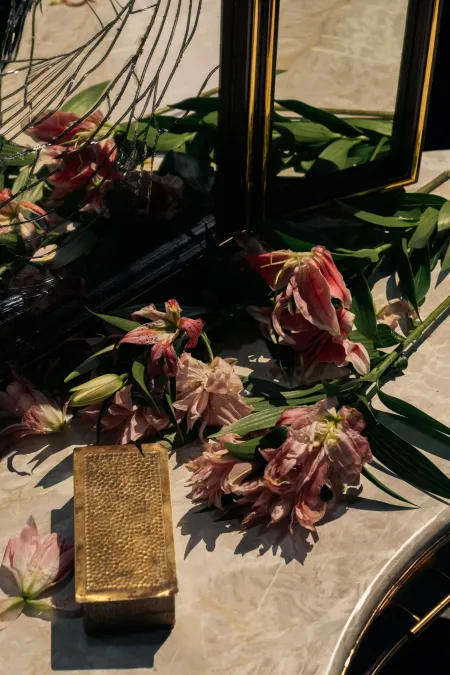
And the stage itself? It reflects a world where life becomes a show and humanity slowly disappears. “We aim to sharpen the audience’s perception—the fragility of a person who chooses love and breaks under its weight,” he says. “Violetta appears as a real woman, torn between desire, freedom, and societal coldness.”
“I can hardly wait”
This summer will be a special chapter for Michieletto. “Many of my friends have performed in Bregenz, and they all tell me the atmosphere is amazing, and the parties are fantastic. I can hardly wait.”
With La traviata, Michieletto presents a production courageous enough to reveal truth through beauty. The Seebühne, with its spectacular scenery, becomes a mirror of a world quick to judge, but slow to realize what it has destroyed. A La traviata that delves beneath the surface, challenges all the senses—and offers images that you will not forget.
Damiano Michieletto studied opera and theatre directing at the Scuola d’arte drammatica Paolo Grassi in Milan, as well as literature in his hometown, Venice. With his visually striking, atmospheric productions, he has achieved international acclaim. His work received numerous awards, including the 2015 Laurence Olivier Award for Best Opera Production.

