Interview by Anke Rauthmann
The text was published in issue 4 (7/26).
Reading time 6 Min.
On the Edge of Reality
Media artist Flavia Mazzanti is serving as XR consultant for YUM!, the immersive music theater project by Wen Liu and Studio M.A.R.S., which will celebrate its premiere at the Bregenzer Festspiele in August. Speaking with dramaturge Anke Rauthmann, she discusses her fascination with hybrid forms of perception, the possibilities and limitations of multimedia technologies, and explains what makes working on YUM! so unique.

You are originally trained as a classical musician and completed your violin studies in Italy. What led you to digital art?
Flavia Mazzanti: My journey into digital art began in Vienna. After earning my violin diploma at a conservatory in Italy, I decided to study architecture in Switzerland. Although I was deeply interested in working with space and design, I felt that something was missing. In 2017, I came to the Akademie der bildenden Künste Wien (Academy of Fine Arts Vienna) to pursue my master's degree, where I had my first opportunity to experiment with a wide range of technologies and artistic formats. My graduation project was a hybrid animated short film. Through media art, I finally felt that I had found an artistic language in which my different interests could come together.
Your works have been presented at exhibitions and festivals around the world. How would you explain what you do to someone who has never engaged with multimedia art?
I enjoy experimenting. My work ranges from interactive installations and post-photographic works to animated films as well as virtual and mixed reality projects. I see my practice as a form of artistic research that explores new ways of perceiving ourselves and the world around us. What interests me less than the technologies themselves is the question of how they shape our experience of reality, physicality, and memory—and what happens when physical and digital experiences overlap, giving rise to new forms of perception. Together with my husband Manuel Bonell and his brother Michael, we founded our own studio in Vienna in 2021: Immerea, which focuses on immersive technologies, experimental games, and interactive installations.

Flavia Mazzanti, Solo Ausstellung CONTRAST Galerie, Tokio. Foto © Martin Holtkamp
Flavia Mazzanti's solo exhibition at Gallery CONTRAST Tokyo, 2025, Photo © Martin Holtkamp
You are part of the leading team for YUM! and accompany the project as XR consultant. What did you find particularly exciting about it?
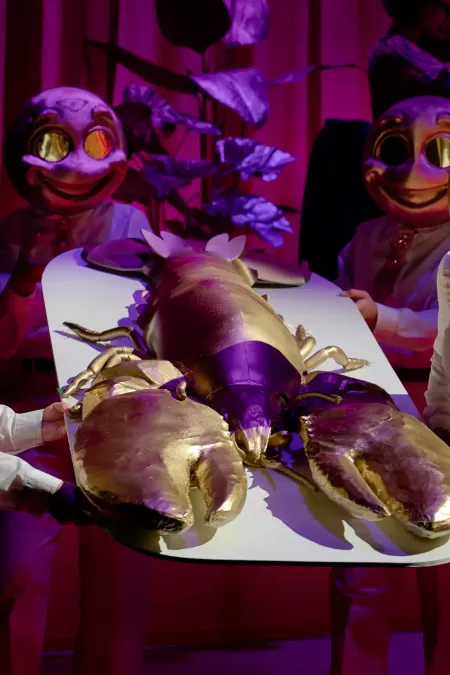
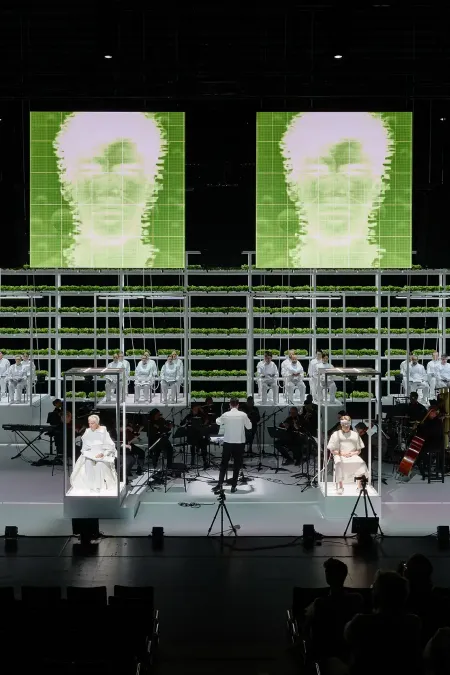
YUM! is an experimental music theater work that combines opera with immersive technologies. At its center is a luxurious dinner that raises questions about consumption, digital staging, and our relationship with resources. Given my background in classical music, I was immediately intrigued when Wen Liu contacted me last year and told me about the project.
Throughout the creative process, I worked at the intersection of artistic vision and technical implementation alongside the Munich-based studio govar, ensuring that the conceptual and aesthetic ideas were translated coherently into digital formats. Together with Wen, I contributed to the development of the immersive elements, advised on the implementation of XR technologies, and collaborated on the visual and spatial design concepts.
What fascinated me most was the way Wen and Studio M.A.R.S. integrate technology into the production. Too often, such technologies are used without serving a clear purpose or meaningful function within the artistic concept. In YUM!, however, they are closely interwoven with the themes and narrative of the work, fulfilling a distinct dramaturgical role. I am delighted to be part of such an exciting collaboration.

Immerea, VR Workshop. Foto © Immerea
Immerea, VR Workshop. Photo © Immerea
The boundaries between reality and staging are becoming ever more fluid.
Could you explain the different technologies in a little more detail?
First of all, I would say that XR is an umbrella term for immersive technologies—it stands for Extended Reality. It encompasses AR, VR, and MR, among other technologies. Augmented Reality (AR) is probably the best-known form: Digital content is overlaid onto the real environment using a smartphone or tablet. With Virtual Reality (VR), users wear a headset and are immersed entirely in a digital environment—the physical world disappears and is replaced by a virtual space. Mixed Reality (MR) also involves wearing a headset, but here the real environment remains visible. Virtual objects are embedded within the physical space and can interact with the real surroundings—digital and physical worlds merge. In YUM!, all of these technologies are used in different ways. Each serves a distinct function within the work.
What kind of impact do you hope the audience will experience?
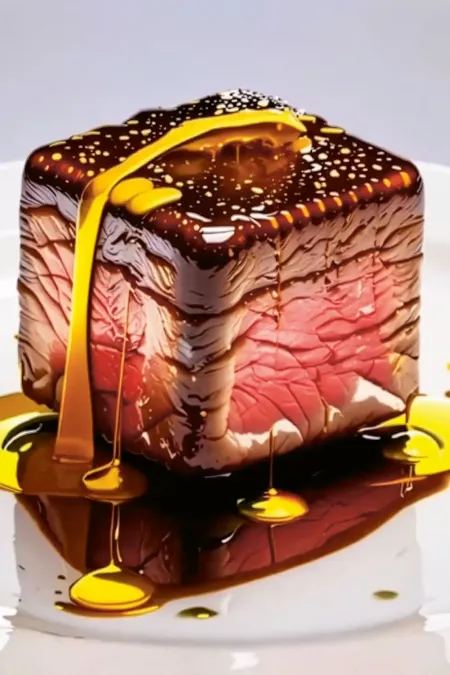
I think the discrepancy between physical reality and virtual perception is a central aspect of YUM! and becomes especially tangible through the act of eating. You taste something real, yet you may be seeing something entirely different. It creates a moment in which your own perception is suddenly called into question.
We live in a time when digital images, algorithms, and virtual spaces increasingly shape the way we perceive, evaluate, and understand the world. The boundaries between reality and staging are becoming ever more fluid. YUM! not only makes this development visible but transforms it into a physical experience. Perhaps this will foster a greater awareness of just how profoundly our perception is influenced by external images, narratives, and technological systems.
What are the challenges of combining live performance with pre-produced and digital material? When does it make sense to incorporate virtual elements in an artistic context?
What makes this combination so compelling to me is its ability to create spaces of experience and perspectives that would not be possible through a single medium alone. Live performance brings with it an immediate sense of presence, physicality, and unpredictability. Digital media, by contrast, opens up perspectives, spaces, and layers of perception that extend beyond physical limitations. At the same time, this is precisely where the challenges lie. These technologies are not always reliable and can present technical difficulties, particularly in a live setting. This becomes especially demanding in a format such as opera, where many different elements have to be synchronized with great precision. It is therefore essential to strike the right balance between a willingness to experiment and technical stability.
Flavia Mazzanti is an award-winning multimedia artist based in Vienna whose work explores the intersection of post-photography, experimental video, and immersive technologies. Named to the Forbes 30 Under 30 list in 2023, her work has been presented at numerous national and international exhibitions and festivals and is part of the permanent collection of the Wien Museum. She is the co-founder of the Vienna-based studio Immerea, which specializes in the development of VR games and interactive installations. In addition, she is a co-organizer of XR Austria and works as both a lecturer and university instructor.