


Text: Julia Schmitt
The text was published in issue 1 (11/26).
Reading time 3 Min.
Images That Take to the Stage
Swiss artist Louisa Gagliardi’s visual worlds accompany the upcoming season of the Bregenzer Festspiele—opening up a fascinating dialogue between painting, music, and audiences.
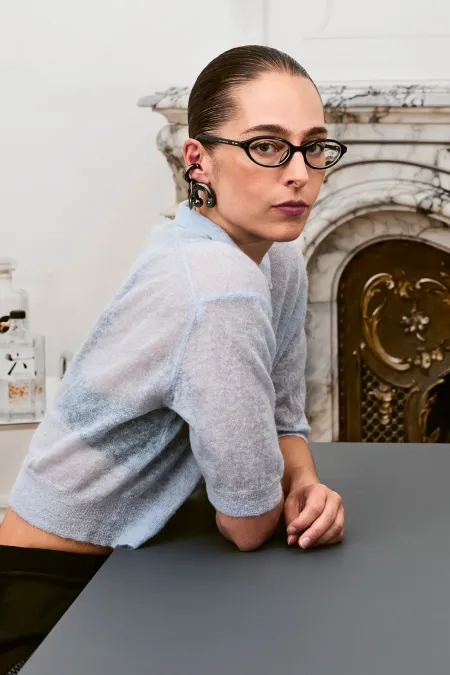
Some images invite us to look, while others look back. Louisa Gagliardi’s works belong to the latter. Her figures do not simply stand within the spaces depicted, but to inhabit them as though on a stage—caught in a moment whose beginning has already passed and whose end is yet to come. As these figures return our gaze, the invisible boundary between the world depicted and the world we inhabit begins to blur. The very boundary known in theater as the fourth wall.
That Louisa Gagliardi’s works will accompany the next season of the Bregenzer Festspiele is therefore more than a combination of visual art and opera. Her works possess an inherently theatrical quality. As we explore her visual worlds, we cannot know what happened before the moment depicted, much less what will follow. A figure stands in a room, sits at the edge of a scene, or meets our gaze. Everything seems charged with energy, yet the tension never resolves into a clearly defined narrative. Gagliardi does not tell stories in the conventional sense. Instead, she captures the moments in which stories become possible.
An image can have multiple lives.
Her principal sources of inspiration are cinema and photography. She explores how a camera frames a scene, how light creates atmosphere, and what remains beyond the frame. The unseen becomes part of the image. Her ideas may emerge from a memory, a dream, or an image that has lingered in her mind. Her figures, too, have neither biographies nor identities. They become vessels for emotions and ideas, inviting viewers to project their own experiences onto them. We instinctively fill in what the image leaves unsaid. Perhaps this is where the true strength of her painting lies: Gagliardi trusts in the creative power of what remains unseen.

Night Caps, 2022, Motiv für die Reihe der Kammerkonzerte
In her visual worlds, the spaces themselves carry as much meaning as the figures that inhabit them. Familiar places seem strangely distant, while architecture evokes intimacy, isolation, or a sense of being in transition. Here, her images and the world of opera converge: Opera, too, moves between reality and fiction, body and role, individual emotion and sweeping narrative.
Gagliardi’s figures inhabit a similar space in between. Their surfaces appear cool, almost synthetic. And yet something human and vulnerable clings to them. This contradiction is also embedded in the technique behind her works. The artist first develops her images digitally, then prints them onto PVC before editing their surfaces with materials such as gel and nail polish. The seemingly smooth texture begins to bear the traces of the artist’s hand.

Got a light, Motiv für die Oper im Festspielhaus Penthesilea
This tension between artificial perfection and human fragility reflects a world in which we constantly observe, present, and reshape ourselves: “I am interested in identity, perception, and human interaction, particularly the tension between intimacy and distance. Technology and social media have profoundly changed how we see ourselves and one another. I believe this feeling of being connected and isolated at the same time naturally finds its way into my work,” the artist explains.
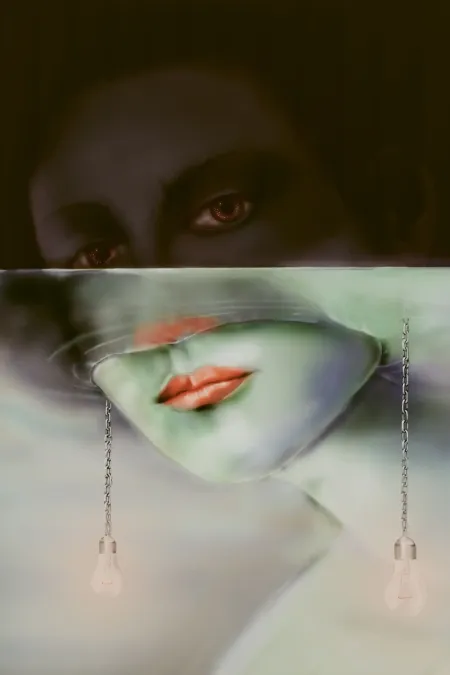
Taking a Dip, 2021, Motiv für das Spiel auf dem See La traviata
Perhaps it is precisely this state of suspension that connects her images so closely with opera. When a work enters a new context, the way we perceive it changes. When her work Taking a Dip (2021), for example, is placed in the context of La traviata, Got a light (2022) alongside Penthesilea, or Night Caps (2022) in connection with the chamber music concerts, these images suddenly begin to evoke different stories. Gagliardi does not see this as an appropriation, but rather as an opportunity: Once an artwork leaves the studio, it opens itself up to new interpretations. “An image can have multiple lives.”
This is the kind of beauty that painting and opera share: Both understand that a story does not need to be told in its entirety. It takes shape in the space between—between stage and audience, figure and viewer. Louisa Gagliardi’s returning gaze makes this boundary tangible. The fourth wall does not fall. It simply becomes thin enough to see through. And suddenly, we are no longer certain who is looking at whom.