


Interview by Babette Karner.
The text was published in issue 1 (11/26).
Reading time 6 Min.
Following in the Footsteps of the Lady of the Camellias
Australian soprano Stacey Alleaume has already captivated audiences in Bregenz as Gilda in Verdi’s Rigoletto—now she returns to the Seebühne as Violetta in La traviata. In this interview, she reflects on extraordinary moments on stage and her deep connection to a woman whose story reaches far beyond the opera.

You have already performed on the Seebühne as Gilda in Verdi’s Rigoletto. What makes this stage so special to you—and what are its greatest challenges?
Stacey Alleaume: Not everyone who comes to see the Opera at the Lake is a passionate opera fan or opera expert. Quite the opposite: For many, it is their very first encounter with the art form. Being able to share that moment with them is something truly special to me. The Bregenzer Festspiele plays an important role in making opera accessible to a wider audience and breaking down barriers. Perhaps that first experience will inspire them to discover more—and visit an opera house.
The challenges in Bregenz, however, are enormous! First, there is the weather: Wind and rain during some performances, sometimes extreme heat during afternoon rehearsals. Then there is the sheer size of the stage. You really have to be physically fit to cover all those distances. And you are asked to do things you would hardly ever encounter on a conventional opera stage: Singing an aria as Gilda 15 meters above the ground, suspended in a basket beneath an enormous helium balloon, with your legs dangling freely in mid-air. Or wading through water as Violetta in a negligee—regardless of the temperature.
But the greatest challenge for me is singing an already vocally demanding role for two hours without an intermission. Altogether, I spend less than 15 minutes backstage, most of which I need for quick costume changes. It requires tremendous physical and vocal stamina.

Violetta experiences great love, happiness, and profound suffering. How do you connect with her emotional world? And how much of yourself do you bring to the role?
It may sound like a cliché, but the moment I step onto the stage, I am no longer Stacey—I become Violetta. I have to immerse myself in her world, understand her thoughts, and fully embrace her story.
What moves me most about Violetta is her constant struggle between her desire to love and embrace life to the fullest—and the reality of her illness. I want to convey her incredible strength and determination, but also the physical and emotional toll they take on her. It is about finding a balance between vulnerability and resilience, allowing the audience to experience the full depth of her humanity. Of course, I bring my own emotions and experiences to the role. But ultimately, I want to understand Violetta and tell her story as truthfully as possible.
The moment I step onto the stage, I am no longer Stacey—I become Violetta.
You have sung Violetta in many different productions. How has your relationship with the character evolved over the years?
I feel a deep connection to Violetta. Over the years, I have discovered more and more facets of her character: Her temperament, her vulnerability, her strength, her capacity for love, and ultimately the sacrifices she makes.
I have also spent a great deal of time researching Marie Duplessis, the famous Parisian courtesan who inspired Alexandre Dumas the Younger’s novel La Dame aux Camélia and, in turn, Verdi’s Violetta. My fascination with her story even took me to Normandy, where I followed a route of approximately 47 kilometers through the places where Alphonsine Plessis, as she was originally known, spent the first 14 years of her life. She would later become Marie Duplessis, the most famous courtesan in Paris and the inspiration for the Lady of the Camellias.
A particularly moving moment awaited me in the village of Exmes. By a fortunate coincidence, I met a journalist there who introduced us to the current owner of the house where Alphonsine had lived for almost a year, working for the Denis family—earning only 60 francs a year.
When I stepped inside that house, I was overwhelmed. Suddenly, I felt incredibly close to her. I even spontaneously sang the aria “Sempre libera” right there!
To me, Violetta is more than an opera character. Behind her is a woman who truly lived. Discovering the landscapes and villages of her childhood, gaining a sense of the world she came from and eventually escaped, has enriched my interpretation. Today, I can tell her story with even greater authenticity and humanity.

What was your most memorable moment on the Seebühne last summer?
It always gives me goosebumps to look out at the packed outdoor auditorium with its nearly 7,000 spectators. You can practically feel the excitement and anticipation in the air! Every so often, there’s a moment on the Seebühne when you suddenly realize just how extraordinary the scale of this festival really is.
In Rigoletto, I began my performance hidden inside the enormous hand of the giant clown. Just before it opened to reveal me to the audience, I could see the people in the outdoor auditorium.
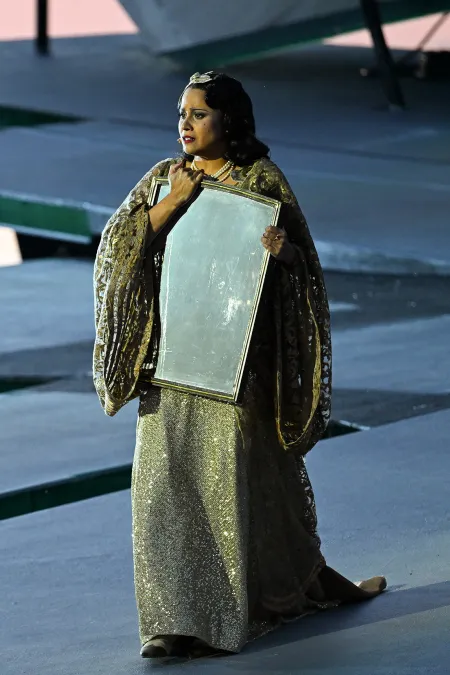
There is a similar moment in La traviata: In my first scene, I enter the stage carrying a mirror. When I turn my back to the audience and raise the mirror to look at myself, I can also see the spectators behind me reflected in it. These are fleeting moments when you suddenly realize just how massive it all is. You feel a real rush of adrenaline. It is precisely these moments that remind me how extraordinary it is to sing and perform on the Seebühne.
Stacey Alleaume is one of the most captivating lyric coloratura sopranos of her generation. Her love of music began at an early age: At seven, she was selected at her elementary school to audition for the National Children’s Choir of Australia—and was instantly captivated. She remained with the choir for seven years before an internship with Opera Australia during high school confirmed her ambition to become a singer. After studying music in Melbourne and pursuing further studies in California, her career took her to opera stages around the world. Away from the stage, she enjoys walks in nature and spending time with her family and her dog.